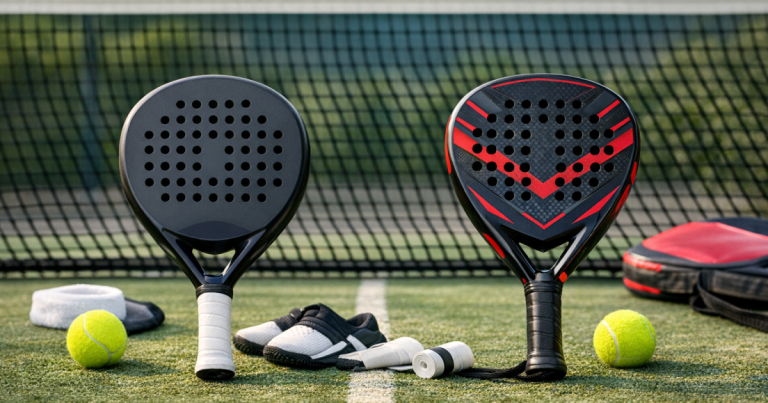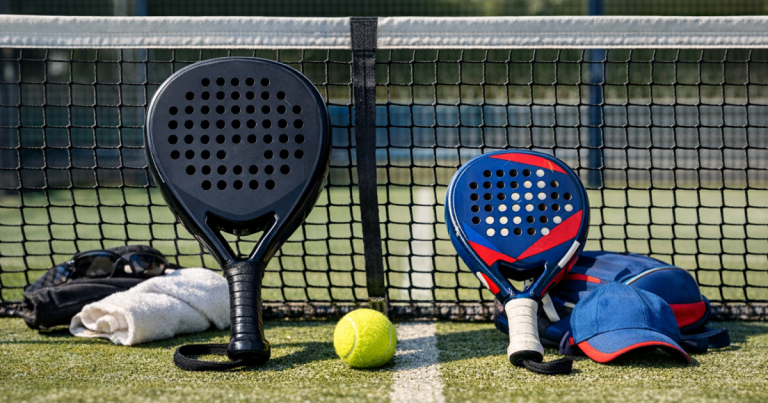
Choosing your first padel racket for club play is less about finding the most powerful frame and more about finding one that helps you keep the ball in play. A forgiving, comfortable racket lets you learn positioning, timing and doubles patterns without fighting the equipment every point.
For most beginners, the sensible choice is a round or easy teardrop racket with a medium-soft feel, a manageable weight and a balance that does not drag the head of the racket through the shot.
The big picture
- Prioritise control before power: club padel rewards consistency, placement and patience more than smash speed.
- Choose forgiveness: a bigger usable hitting area makes off-centre contact less punishing.
- Avoid going too heavy too soon: tired technique can make late contact, mishits and sore arms more likely.
- Test before deciding: ten minutes of gentle hitting is not enough; try volleys, lobs, glass rebounds and defensive blocks.
- Think about doubles: most club games are doubles, so quick reactions at the net matter as much as baseline power.
Why club play changes the decision
A racket that feels exciting for five minutes in a shop can feel very different in a 90-minute club session. Club play asks for repeatable shots: controlled serves, safe returns, compact volleys, recoverable lobs and steady bandejas rather than spectacular winners.
Beginners often overestimate how much power they need. In real games, many points are lost through rushed contact, balls hit into the glass, or volleys pushed too deep. A more forgiving racket gives you a better chance to slow the rally down and make clearer decisions.
It also needs to suit the environment you actually play in. Indoor courts can feel faster and more predictable, while outdoor courts add wind, damp glass and changing light. If you are still deciding where to play most often, this guide to indoor vs outdoor padel can help you understand how conditions affect your early sessions.
Start with racket shape
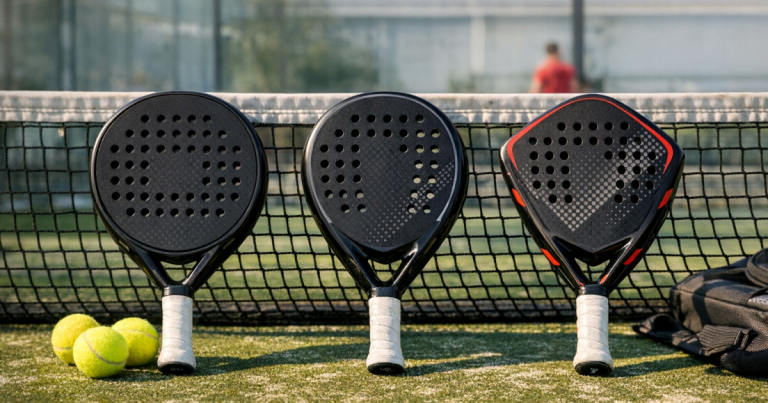
Shape is the easiest starting point because it strongly affects how approachable a racket feels. You do not need to understand every construction detail on day one; you do need to know where the sweet spot tends to sit and how demanding the racket is when your timing is imperfect.
Round rackets
Round rackets are usually the friendliest option for early club play. They tend to place the sweet spot closer to the centre and are often easier to manoeuvre during quick exchanges. If you are still learning how to defend from the back glass, block fast balls and keep volleys tidy, a round shape is a safe place to begin.
Teardrop rackets
Teardrop rackets sit between round and diamond shapes. They can offer a useful blend of control and extra attacking help, but the feel varies a lot by model. A gentle teardrop can work well once you can rally reliably and want a little more help on overheads without jumping to a demanding power racket.
Diamond rackets
Diamond-shaped rackets are generally more attack-focused and can feel head-heavy. Some confident athletic beginners may enjoy them, but they are rarely the easiest route into regular club games. If your contact point is still inconsistent, a diamond shape can make errors feel bigger and reactions at the net feel slower.
Weight and balance matter more than you think
Many adult padel rackets sit in a broad mid-weight range, but the number on the label is only part of the story. Balance changes how that weight feels. A head-heavy racket can feel powerful when fresh, yet awkward when you are defending body shots or reacting to a fast volley exchange.
For beginners, the better question is: can you swing compactly, reset quickly and keep your wrist and forearm relaxed late in the session? If the racket feels slow after twenty minutes, it is probably not the right club-play companion yet.
Grip setup also affects comfort. A grip that feels too small can encourage squeezing; too bulky and it may reduce feel. Overgrips are inexpensive and easy to adjust, so do not judge a demo racket only by the grip it happens to have fitted.
Feel, materials and stiffness without the jargon
Padel rackets are often described using terms such as carbon, fibreglass, soft core, hard core and high balance. These can be useful, but they do not guarantee how a racket will feel in your hand. Two rackets with similar marketing language can behave quite differently on court.
As a beginner, focus on practical sensations:
- Does the ball leave the racket predictably? You want a response you can trust on volleys and returns.
- Can you control depth? If every gentle push flies long, the racket may be too lively for your current technique.
- Does it forgive mishits? Off-centre contact should not make the racket twist dramatically in your hand.
- Does your arm stay relaxed? A racket that encourages tension can make learning harder.
Stiffer rackets can feel precise for some players, while softer-feeling rackets can feel more comfortable and helpful at lower swing speeds. Neither is automatically better. The right answer is the one that supports clean, repeatable contact in your normal rallies.
How to test a racket like a club player
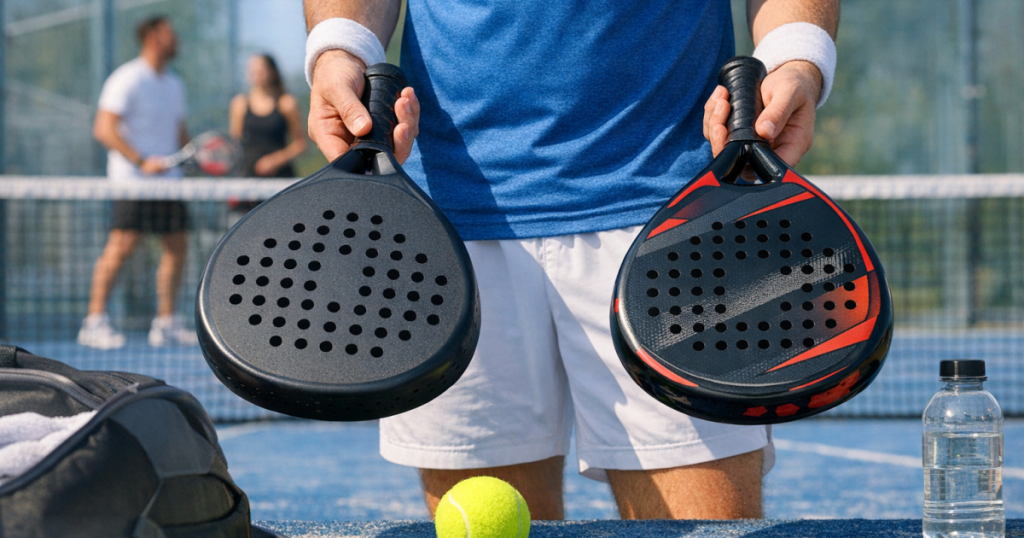
Do not test only the shots you already enjoy. A useful test includes the awkward parts of beginner padel: low defensive balls, half-volleys, blocked returns, lobs under pressure and quick reactions at the net. These are the moments that decide many early club points.
A simple test routine is enough:
- Hit controlled forehands and backhands from the back of the court.
- Play several volleys without swinging big.
- Try lobs when moving backwards.
- Defend balls after the glass if you can.
- Serve and play the first volley, because this pattern appears constantly in doubles.
- Notice how the racket feels after you are slightly tired, not just when fresh.
If you can borrow or demo before committing, use a structured approach rather than relying on first impressions. The advice in how to test padel gear before you buy is especially useful when you are trying to separate excitement from long-term suitability.
Real racket examples to use as reference points
You do not need to chase a professional player’s racket for early club padel. Instead, use real models as reference points when you are learning what different shapes and feels are like. Always verify current model details, weight, balance and return policies with the retailer or club before buying.
- Head Evo Speed Padel Racket is a recognisable beginner-friendly reference point to compare against more demanding frames.
- Adidas Drive Light 3.3 Padel Racket is worth handling if you want to understand how a lighter-feeling racket can affect manoeuvrability.
- Wilson Pro Staff Team V2 Padel Racket can be a useful comparison if you are testing control-focused club rackets from mainstream brands.
These are not automatic choices for every beginner. Treat them as practical examples to hold, demo and compare with other rackets available at your local club or retailer.
Common first-racket mistakes
- Buying for power too early: a powerful racket will not fix late preparation or poor shot selection.
- Ignoring defensive shots: if the racket only feels good when attacking, it may frustrate you in real doubles rallies.
- Choosing by looks alone: colour and brand matter less than comfort, control and confidence.
- Copying an advanced player: their timing, strength and court awareness may be very different from yours.
- Forgetting the rest of the session: shoes, balls, water and a grip can affect how your racket feels on court.
If your first proper hit is coming up soon, it is worth checking what to pack for your first padel session so the racket is not the only thing you think about.
Match the racket to your first few months
Your early club padel will probably move through stages. At first, you need to get the ball back, understand walls and avoid panicked swings. Then you start placing lobs, holding the net and choosing smarter targets. Later, you can think more seriously about extra power or a more specialised feel.
That is why your first club racket should give you room to learn. It should not be so basic that you outgrow it immediately, but it should not punish every small timing error either. A comfortable round or easy teardrop frame usually gives beginners the best bridge into regular matches.
Club padel is also a rules-and-positioning game. Once your racket feels settled, spend time understanding serving order, receiver choice and rotation, because those decisions shape rallies before the ball is even struck.
Things readers ask
Should my first club racket be round or teardrop?
Most beginners should start with a round racket because it is usually more forgiving. A gentle teardrop can also work if you already make consistent contact and want a little more attacking help.
How much should I spend in £?
Set a budget you are comfortable with, then prioritise testing and return flexibility over chasing the highest price. More expensive does not automatically mean easier for beginners.
Is a lightweight racket always better?
No. A lighter racket can be easier to move, but it still needs to feel stable on blocks, volleys and off-centre hits. Balance and comfort matter alongside weight.
Can I use a tennis racket for padel?
No. Padel uses a solid, stringless racket designed for the sport. Tennis rackets are not suitable for padel courts, rules or normal club play.
When should I upgrade?
Upgrade when you know what your current racket is limiting. If you want more precision, easier overheads or a different balance, test alternatives against those specific needs.
Why it matters
The right beginner racket will not win points for you, but it will make good habits easier to build. Look for control, forgiveness, comfort and quick handling before raw power. If a racket helps you relax, defend, volley and keep rallies alive in club doubles, it is doing its job.