Walking onto court for your first padel session is much easier when you know what to book, what to bring, and how the space works. You do not need advanced technique, expensive kit, or a deep understanding of tactics. The aim is simple: turn up prepared, play safely, enjoy the rallies, and leave with a clearer idea of what to practise next.
At a glance
- Book a beginner-friendly court slot, intro session, or social game rather than a highly competitive match.
- Wear comfortable sports clothing and grippy court shoes if you have them; avoid smooth running shoes on sandy artificial turf.
- Hire or borrow a racket for the first few games before buying your own.
- Arrive early so you can find the courts, check in, warm up, and ask how the booking system works.
- Focus on keeping the ball in play, learning the walls, and understanding the basic serve rather than hitting winners.
Booking the right kind of session
For a first game, the type of booking matters more than the exact venue. Look for wording such as beginner session, intro to padel, coaching clinic, social mix-in, or open play. These formats are usually more forgiving than booking a full match with three players who already play regularly.
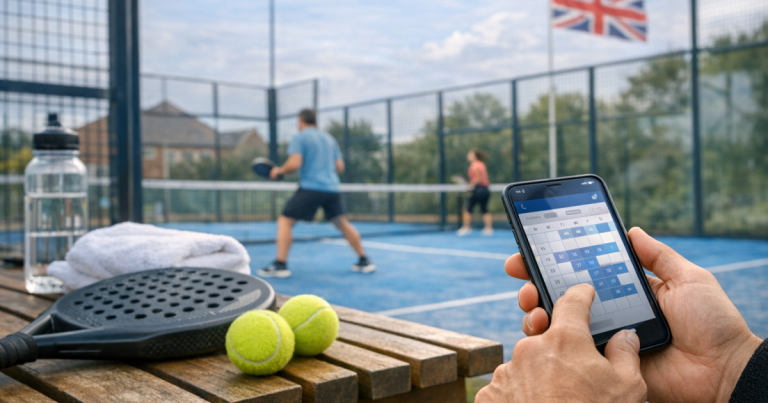
Most UK padel venues use online booking through their own website, a club system, or a sports booking app. You will normally choose a court, date, time, and session length. Common slots are 60 or 90 minutes, which is plenty for beginners. If you are booking with friends, check whether the system requires one person to pay for the whole court or whether each player pays separately.
If you are not sure where to start locally, the guide on how to start playing padel in the UK explains the usual routes into club play, coaching, and social sessions.
What to check before you confirm
- Racket hire: many venues offer hire rackets, but not all include them automatically with the court booking.
- Balls: check whether balls are supplied, available to buy at reception, or expected from players.
- Level: beginner, improver, intermediate, and advanced labels vary by venue, so read the description carefully.
- Indoor or outdoor court: outdoor courts can be affected by rain, wind, cold, and low sun.
- Cancellation rules: some centres have strict cut-off times, especially for peak evening slots.
Kit to take without overthinking it
You can keep your first kit list very simple. Wear sports clothing that lets you move, turn, and reach overhead comfortably. Padel involves short bursts, side steps, lunges, and quick changes of direction, so avoid anything too restrictive.
Shoes are the one area worth taking seriously from the beginning. Padel courts usually have artificial turf with sand, and the surface can feel slippery if you wear smooth-soled running shoes. Proper padel shoes or tennis-style clay court shoes give better grip for sideways movement. If you are still deciding what to wear, read how to choose your first padel shoes before spending money.
For the racket, hiring is perfectly sensible at the start. A beginner-friendly racket usually feels manageable, not too heavy, and easy to control. Avoid judging your ability by the racket in your hand during the first session; timing, positioning, and confidence matter far more. Once you have played a few times, you will have a better feel for whether you prefer something lighter, softer, or more powerful.
A simple first-session bag
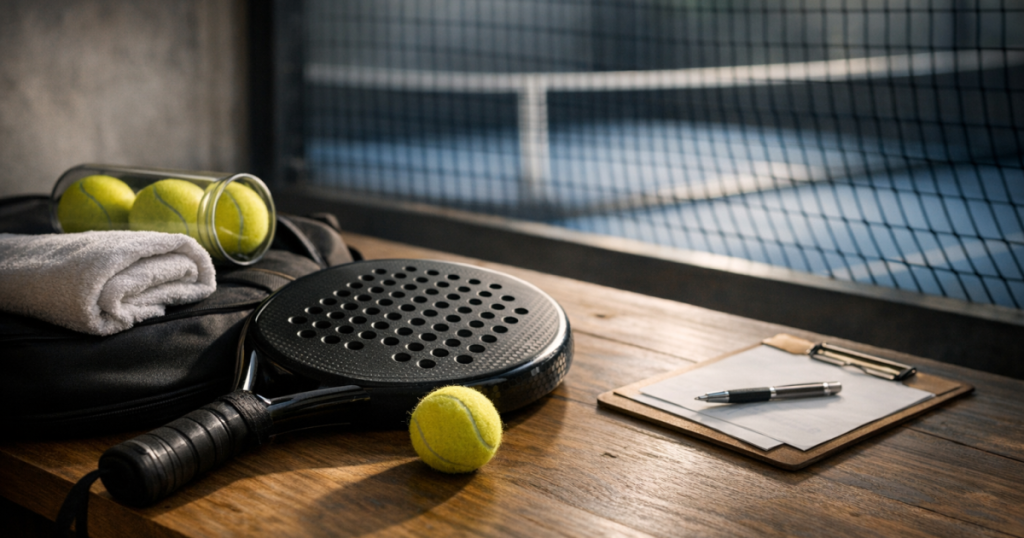
- Sports top and shorts, leggings, or tracksuit bottoms.
- Grippy court shoes or the most stable sports shoes you already own.
- Water bottle; 60 to 90 minutes can feel surprisingly active.
- Small towel, especially for indoor courts or warmer weather.
- Racket if you own one, or confirmation that hire is available.
- Padel balls if the venue asks players to bring their own.
- A light layer for outdoor courts, particularly in the evening.
Arriving at the venue
Try to arrive 10 to 15 minutes early. That gives you time to park, find reception, collect any hire kit, locate the court, and use the changing facilities if needed. Padel clubs can be busy, and first-time players often lose a few minutes simply working out which court is theirs.
When you check in, ask practical questions rather than feeling you should already know everything. Useful questions include: where are the courts, are the lights automatic, where do used balls go, do you need to lock the court afterwards, and is there a gate system for entry?
Before play starts, spend a few minutes warming up. Begin with light jogging, shoulder circles, gentle side steps, and easy hits from the service boxes. Avoid smashing or swinging flat out immediately. Padel rewards control and timing, and a relaxed warm-up helps you settle into the pace of the ball.
How the court works
A padel court is 20 metres long and 10 metres wide, divided by a net. It has glass or solid walls at the back and sides, plus fencing sections. The walls are part of the game once the ball has bounced on the ground. That is one of the main reasons padel feels different from tennis or squash.
The most important court markings for beginners are the service boxes and the centre line. Serves are played diagonally into the opposite service box. During rallies, you do not need to aim for boxes; the whole court area on your opponent’s side is generally in play, subject to the normal rules around bounces and walls. For a clearer visual breakdown, see this beginner guide to padel court lines and boundaries.
The wall rule in plain English
The ball must bounce on the ground before it hits your opponent’s back or side wall. If you hit the ball directly into their wall without it landing in first, it is out. On your own side, you can let the ball bounce, rebound off the glass, and then play it back before it bounces a second time. This feels strange at first, but it quickly becomes one of the most enjoyable parts of the game.
A helpful beginner habit is to pause for a split second when the ball goes towards the back glass. New players often rush forward and crowd the bounce. Give the ball space, let it come off the wall, then make a controlled swing.
Basic rules you need before the first rally
You do not need to memorise every rule before playing, but a few basics will stop the game feeling chaotic. Padel scoring follows tennis scoring: 15, 30, 40, game, with sets usually played to six games. Social sessions may use shorter scoring formats, especially if players are rotating on and off court.
The serve is underarm. The server lets the ball bounce behind the service line, strikes it below waist height, and sends it diagonally into the opposite service box. The serve must land in the box before it can touch the glass. If it hits the side fence after landing, it is normally a fault.
During rallies, each side has one bounce available. You can volley before the bounce, play after one bounce, or use your own back glass after the ball has bounced. The ball cannot bounce twice on your side. If it does, the point is over.
For a fuller beginner explanation, the guide to serving, walls, and faults in padel is a useful next step once you have played or booked your first game.
What to focus on while playing
Your first aim is not to win points with power. It is to keep rallies going long enough to learn the rhythm of the game. Padel is usually played as doubles, so communication and positioning matter from the first few minutes.
- Call simple words: use “mine”, “yours”, “leave”, and “switch” to avoid both players chasing the same ball.
- Stay as a pair: if one player moves forward and the other stays deep, gaps open quickly.
- Use controlled swings: shorter swings make it easier to handle the glass and react at the net.
- Aim cross-court: diagonal shots give you more court to work with and often feel safer.
- Reset when under pressure: a gentle lob or slower shot can be smarter than trying to hit through opponents.
Expect mistakes. You will misjudge rebounds, serve into the net, stand too close to the glass, and occasionally forget the score. That is normal. The best beginners are not the ones who hit hardest; they are the ones who adjust, communicate, and keep enjoying the learning process.
After the session
Give yourself five minutes afterwards to notice what felt easy and what felt confusing. Did you struggle with the walls? Did your shoes slip? Did the racket feel heavy? Did you enjoy doubles movement, or would a coaching session help you feel more comfortable?
If you liked the session, book the next one soon. Padel becomes easier when the first few games are close together, because your brain starts recognising bounces, court positions, and serve routines. Playing once, then leaving a long gap, can make every session feel like starting again.
What to remember
A good first padel experience is not about perfect technique or having all the right gear. Book a suitable beginner slot, wear shoes that let you move safely, hire a racket if needed, arrive early, and learn the court one rally at a time. Once you understand the serve, the walls, and the basic flow of doubles, the game starts to feel much less mysterious and much more fun.