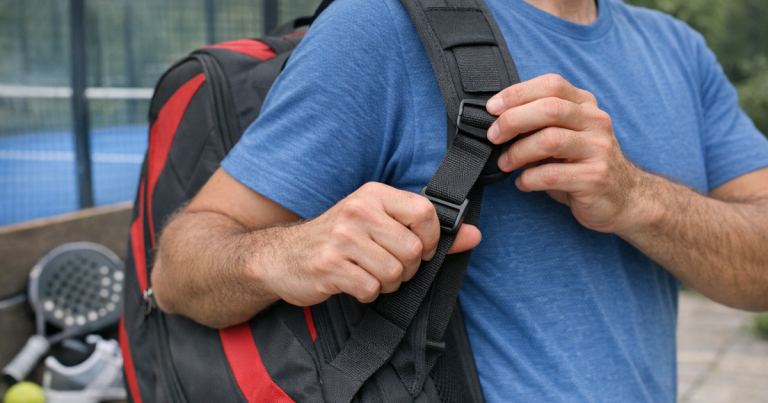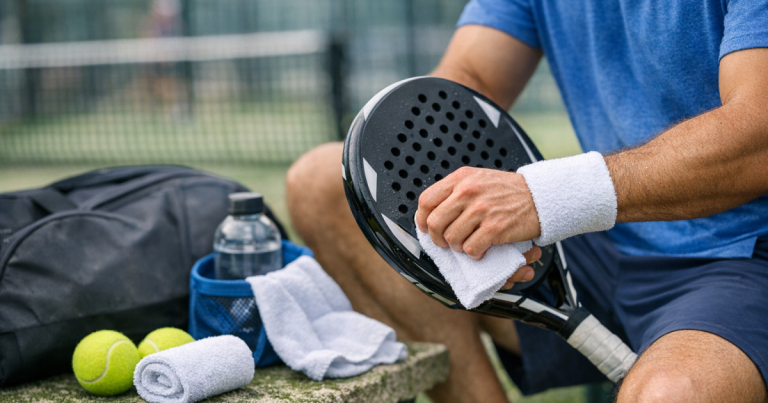
At a busy club, it is easy to focus on booking in, finding a court and warming up, then leave your phone or wallet loose in a side pocket. Good padel bag security is mostly about simple habits: bring less, know where your bag is, and use the club’s storage properly. The aim is not to worry through the whole session, but to make theft, mix-ups and forgotten items much less likely.
Most beginner players do not need a complicated setup. A tidy bag, a small routine before you step onto court, and a sensible decision about what stays at home will solve most of the common problems.
At a glance
- Only take the valuables you genuinely need for the session.
- Use club lockers when they are available, especially for wallets, car keys and jewellery.
- Keep your bag zipped and positioned where you can see it between points.
- Use internal pockets so small items do not fall out when you grab a towel or water bottle.
- Do a quick check before leaving the court, changing area and reception.
Step 1: Bring fewer valuables in the first place
The easiest item to protect is the one you did not bring. Before leaving for the club, think about what you actually need for that session: phone, keys, payment card, water bottle, towel and playing kit are common essentials. A full wallet, spare jewellery, extra bank cards, work pass, headphones and loose cash are often unnecessary.
If you are new to padel, this is also a good time to streamline your overall kit. A simple starter setup is easier to manage than an overloaded bag, and the padel starter kit checklist for first-time players can help you separate useful items from things you can leave at home.
A simple pre-club valuables check
- Take one payment method rather than several cards.
- Remove non-essential ID cards from your wallet.
- Leave expensive jewellery at home unless you need it immediately before or after the session.
- Carry only the keys you need, rather than a full keyring with home, office and storage keys.
- Put small essentials into one inner pocket before you travel, not after you arrive.
This matters because club environments are busy. Bags get moved, benches fill up, and players often switch courts quickly. The less you carry, the less you have to monitor.
Step 2: Know the club’s storage options before you play
Different padel clubs handle storage differently. Some have lockers in the changing rooms, some have open shelves near reception, and others expect players to keep bags court-side. Do not assume the setup will be the same as your last club.
When you arrive, take 30 seconds to ask where bags are usually kept. If lockers are available, check whether you need your own padlock, a token, a code, or reception assistance. If there are no lockers, look for the most visible, low-traffic place to keep your bag.
What to check at a new club
- Are lockers available to casual players as well as members?
- Can bags be brought onto court, or must they stay outside?
- Is there a staffed reception area near the bag storage zone?
- Are changing rooms open throughout your booking time?
- Will you need a small padlock for future visits?
If you are hiring equipment for your first few sessions, you may be carrying fewer items anyway. That can be useful while you learn the club routine. The guide to club racket hire versus buying for your first padel sessions explains when it makes sense to keep things light before investing in your own racket and bag.
Step 3: Use a sensible bag layout
A messy bag makes valuables harder to protect. If your phone is loose beside balls, overgrips, snacks and a spare top, you are more likely to leave pockets open or tip items out without noticing.
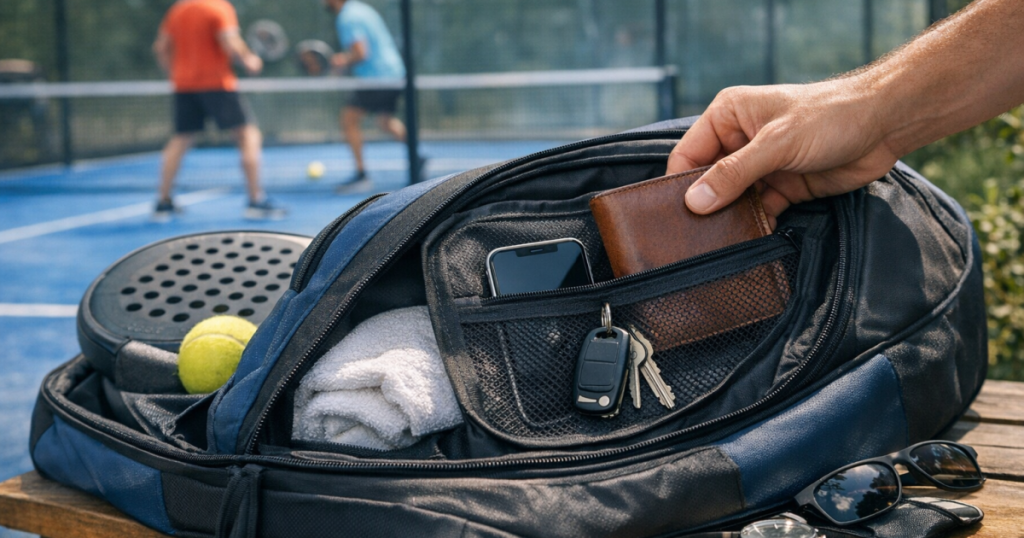
Give every important item a fixed place. Your phone might always go in the top inner pocket, keys in a zipped side section, and payment card in a small pouch. The exact layout is not important; consistency is.
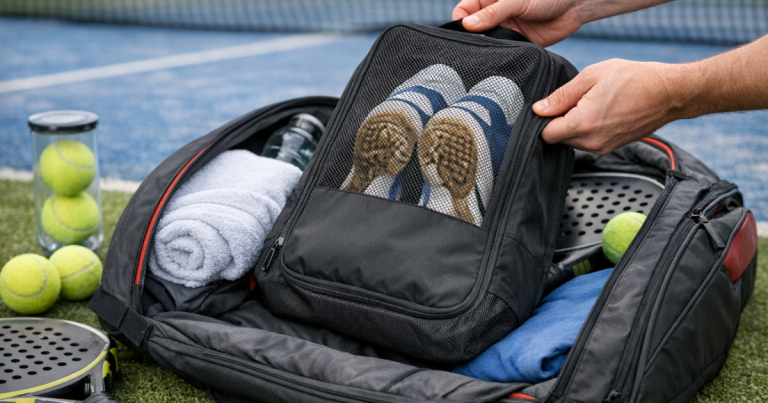
A beginner-friendly packing layout
- Main compartment: clothing, towel and larger soft items.
- Racket section: racket only, so the zip does not catch on loose accessories.
- Small internal pocket: phone, card holder and locker key.
- Side pocket: grip, tissues, lip balm or other low-value items.
- External bottle holder: water only, not keys or phone.
A small pouch can help if your bag has limited pockets. Choose one that is easy to spot inside the bag, rather than a dark pouch that disappears into the lining. Keep it zipped and use it only for valuables, not general clutter.
Step 4: Keep valuables out of the easiest-to-reach pockets
External pockets are convenient, but they are also the easiest places for items to fall out or be lifted when the bag is left open. They are fine for wristbands, tissues, spare grips and snacks. They are not ideal for phones, wallets or keys unless the pocket is zipped and the bag stays with you.
Many players unzip their bag quickly between games to grab a towel or drink. If valuables are in the same area, they can slide out onto a bench or court-side floor. Put the most important items in a separate zipped pocket that you do not need to open during play.
Step 5: Decide where the bag sits during the match
If bags are allowed court-side, place yours in a spot that is visible but not in the way. Corners near the entrance can become busy when players change ends or collect stray balls, so a bench or bag rack may be better if the club provides one.
A good spot has three qualities: you can see it from the court, other players are unlikely to trip over it, and you do not need to keep moving it. Avoid leaving it half-open on the floor near the door, where people naturally pass in and out.
During play, build a light-touch routine
- Zip the bag before the warm-up starts.
- Keep your phone silent and inside the bag, not balanced on a bench.
- Check the bag position when changing ends, without turning it into a distraction.
- Do not ask a stranger on the next court to watch your valuables.
- If you leave the court for the toilet or reception, take the most important items with you or use a locker first.
For your first coaching session, ask the coach or reception team where players usually leave bags. It is a normal question, and it lets you focus on the lesson rather than your belongings. If you are preparing for a lesson soon, the guide on how to prepare for your first padel coaching session covers the broader session basics too.
Step 6: Use lockers properly when they are available
A locker is usually the best option for valuables, but only if you use it well. Do not leave the locker door pushed shut without locking it, and do not leave the key in an obvious outer pocket of your bag. If the locker uses a code, choose something you can remember but not something obvious like repeated numbers.
If you use your own small padlock, test it before leaving home. A stiff lock or forgotten combination can turn a simple storage choice into a hassle just before your court time. For club use, a compact combination lock is often easier than carrying another tiny key, but either can work if you keep the routine consistent.
Locker habits that reduce mistakes
- Put all valuables in the locker at once rather than returning several times.
- Check the door has actually latched before walking away.
- Keep the locker key or code with you in the same place every time.
- Empty the locker before going to the car, café or bar area.
- Do one final glance inside the locker before closing it for the last time.
Step 7: Be careful after the match, when mistakes happen
Many lost items are not stolen; they are forgotten. After a close match, players chat, check scores, collect balls, change shoes, reply to messages and head off quickly. That is exactly when phones, locker keys and wallets get left on benches.
Before leaving the court, use the same short checklist every time: racket, phone, keys, wallet or card holder, water bottle, towel. Say it in your head while touching each item. It takes less than 20 seconds and becomes automatic after a few sessions.
If you stay for a drink or watch another match, keep your bag zipped and close to you. Social areas are busier and less predictable than a booked court, especially at peak evening times. Do not leave your bag under a table and assume you will remember it later.
Common club scenarios and what to do
You are playing straight after work
You may have more valuables than usual: laptop, work pass, headphones, documents or smart clothing. If the club has lockers large enough, use one. If not, consider leaving work items in a secure place before travelling, rather than bringing everything court-side.
You arrive by public transport
You may not have a car as a fallback storage option, so packing light matters more. Keep your payment card, phone and keys together in an inner pouch, and avoid carrying extra items that make the bag bulky or harder to supervise.
You are sharing a court with people you do not know
Most club games are friendly, but you should still use normal public-place judgement. Keep your own bag zipped, avoid leaving valuables loose on benches, and do not make another player responsible for watching your things.
You are in a rush between bookings
This is when a fixed packing system helps. If every item has a usual pocket, you can spot what is missing quickly. Rushing is not a reason to skip the check; it is the reason the check exists.
Helpful questions
Should I take my phone onto the padel court?
Usually yes, if you need it for travel, payment, emergencies or club access, but keep it zipped inside your bag rather than loose on a bench. If lockers are available and you do not need the phone during the session, storing it there is safer.
Is it rude to ask the club where to store valuables?
No. It is a normal beginner question. Reception staff and coaches would rather you ask before playing than lose time searching for a missing item afterwards.
Can I lock my whole padel bag?
You can, but it is not always practical because you may need your towel, water or spare grip during play. It is usually better to lock valuables in a locker and keep low-value kit in the bag.
What should I do if something goes missing?
Check the court, bench, locker, changing area and reception first. Then tell club staff promptly, give a clear description, and ask whether lost property is logged or stored in a specific place.
Do I need a specialist anti-theft padel bag?
Most beginners do not. Better habits, zipped inner pockets and proper locker use usually matter more than buying a specialist bag. Consider a different bag only if your current one has no secure pockets or is awkward to manage at clubs.
Key takeaways
Secure club habits are simple: carry fewer valuables, give important items a fixed pocket, use lockers when available, and keep your bag zipped and visible. Padel bag security improves most when your routine is repeatable, not when it is complicated.
Before your next session, remove one unnecessary valuable from your bag and decide exactly where your phone, keys and payment card will live. That small decision can make the whole club visit feel calmer and easier.