Your first racket should make padel easier, not louder. The debate around control vs power padel rackets matters because beginners win more early points by keeping the ball in play, learning the glass and finding the middle of the racket consistently.
Power is tempting, especially if you come from tennis or squash and already like hitting through the ball. But padel rewards placement, patience and recovery more than raw speed. A racket that feels manageable in your hand usually helps you build those habits faster.
The short version
Most first-time and early-stage players should start with a control-focused or balanced racket rather than a very power-focused one. That does not mean buying the softest or cheapest racket available. It means choosing a shape, balance and feel that help you defend, volley and reset points without fighting the racket.
A power racket can work as a first racket for a strong, technically tidy player who already strikes the ball cleanly and has tried padel enough to know what they like. For most beginners at UK club sessions, social matches and coaching groups, the better first choice is the one that gives you more playable contacts, not the one that promises the biggest smash.
If you are still setting a budget, it is worth reading how to choose your first padel racket without overspending before you get pulled towards advanced-looking models.
What control really means in a padel racket
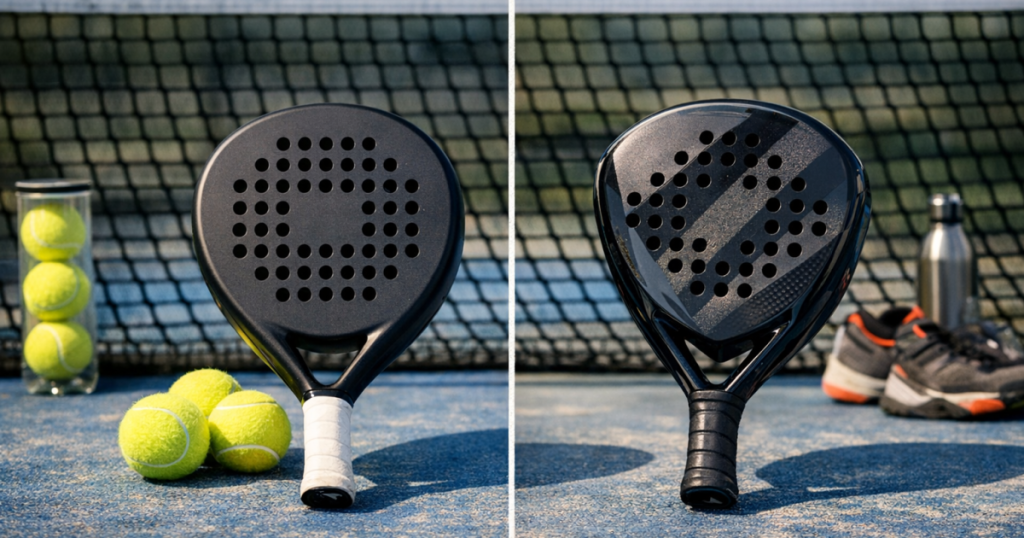
A control racket is designed to make the ball easier to direct. In practical terms, that usually means a more forgiving hitting area, a balance that is not too head-heavy, and a feel that helps you judge depth on slower shots. These rackets often suit players who are learning bandejas, blocked volleys, lobs and defensive shots off the glass.
For a beginner, control is not about playing cautiously forever. It is about having enough margin to make sensible decisions. If you can keep the rally going, you get more chances to practise court positioning, communication with your partner and shot selection. Those skills matter far more than winning one point with a huge hit followed by three unforced errors.
Round-shaped rackets are often associated with control because they tend to place the sweet spot more centrally. Teardrop rackets can sit in the middle ground. Diamond-shaped rackets are often marketed towards power because more mass can feel concentrated towards the top of the frame. These are useful clues, but they are not strict rules. Always check the actual model, current version and how it feels in your hand.
What power really gives you
Power rackets are built to help generate speed on attacking shots. They can feel lively overhead and satisfying when you catch the ball cleanly. For players with good timing, strong technique and confident footwork, that extra punch can make volleys, smashes and aggressive returns more threatening.
The trade-off is that power-focused rackets can be less forgiving. If the sweet spot feels smaller, the balance feels high, or the face feels firm, small timing errors become more noticeable. Beginners often experience this as balls flying long, defensive shots dying in the net, or the racket arriving late when they are under pressure.
That is why the control vs power padel rackets decision is less about personality and more about repeatable contact. A player who can already prepare early, move into position and strike cleanly may enjoy extra power. A player still learning where to stand after serving will usually improve faster with easier control.
How the differences show up on court
The difference becomes obvious in ordinary club situations, not just when you hit a smash. Think about these common beginner moments:
- Returning serve: a forgiving racket helps you block the ball back low and steady instead of taking a rushed swing.
- Defending after the glass: control helps you lift the ball with enough height and depth to recover your position.
- Volleys at the net: a manageable racket makes it easier to guide the ball into space rather than overhitting.
- Lobs: good control gives you confidence to send the ball high and deep without panicking.
- Overheads: power helps when your technique is ready, but poor preparation still beats the racket every time.
Most early points are not lost because the ball was too slow. They are lost because the player chose too much swing, made late contact or missed the centre of the racket. A control-friendly racket reduces those errors while your technique catches up.
Shapes, balance and feel: the simple beginner checklist
You do not need to memorise every material or marketing term. Focus on the details you can actually feel and verify before buying.
Shape
Round shapes are commonly the safest first stop because they usually feel stable and forgiving. Teardrop shapes can be a good step up if you want a little more attacking help without going fully power-focused. Diamond shapes can be fun, but they are usually less beginner-friendly unless you have already tested one and liked it.
Balance
Balance describes where the racket feels weighted. A lower or more central balance often feels easier to manoeuvre. A higher balance can add punch but may feel harder during quick exchanges, defensive blocks and long sessions. If a racket feels slow in your hand during a warm-up, it probably will not feel better when you are tired.
Weight
A racket can be technically good but still wrong for your arm, timing or fitness. Very light rackets can feel easy to move but may feel less stable against faster balls. Heavier rackets can feel solid but may be tiring. For a deeper look at this trade-off, read the guide to light versus heavy padel rackets.
Face feel
Softer-feeling rackets can help with comfort and depth at lower swing speeds. Firmer-feeling rackets can feel precise and powerful when struck well, but may be less forgiving if your contact is inconsistent. Retail descriptions can help, but a short demo tells you more than a long spec list.
Real racket examples without getting lost in hype
Named rackets can be useful reference points, but do not buy only because a model looks popular online. Versions change, retailers describe categories differently, and your comfort matters more than a professional player endorsement.
- Nox ML10 Pro Cup is often discussed as a control-friendly reference point for club players. Before buying, check the current model details, weight range and whether the feel suits your level.
- Adidas Adipower CTRL is an example of a racket line positioned around control. Treat it as something to test, not proof that every control-labelled racket will suit you.
- Babolat Technical Viper is a recognisable attacking model often aimed at players who want more power. Beginners should be honest about whether they can use that extra response consistently.
The useful lesson from these examples is not that one model is right for everyone. It is that marketing labels need translating into court feel. A racket can say control and still feel demanding. A racket can say power and still be manageable for the right player. Your job is to match the racket to your current game, not the game you hope to have in six months.
Which should you buy first?
Buy a control or balanced racket first if you are new to padel, still learning the walls, playing mostly social games, or finding that your shots vary wildly in height and depth. You will get more value from forgiveness than from maximum speed.
Consider a power-leaning racket first only if you have already played several sessions, can hit the centre consistently, and do not feel rushed in fast exchanges. Even then, avoid choosing the most demanding shape just because it looks advanced. A balanced teardrop racket may give you enough help in attack while keeping rallies manageable.
If you are unsure between two rackets, choose the one that makes your worst shots better. Your best shot will feel good with plenty of rackets. Your defensive block, awkward backhand and late volley reveal whether the racket is really helping.
Try this before you commit
If your club or coach offers demo rackets, test two or three styles during normal drills rather than only hitting smashes for five minutes. Warm up, return serves, defend off the back glass, volley under pressure and play a short set. Notice which racket lets you make calm decisions when you are slightly out of position.
When testing, ask yourself:
- Can I find the middle of the racket without thinking about it?
- Do defensive shots clear the net comfortably?
- Can I control lobs without sending them too short or too long?
- Does the racket feel quick enough in volley exchanges?
- Does my arm feel relaxed after a full session?
For a first purchase, boring feedback is often good feedback. If a racket simply feels easy, predictable and comfortable, that is a strong sign. You do not need fireworks from your first racket; you need something that helps you turn up again next week.
Common questions
Are control rackets only for defensive players?
No. Control rackets can still attack well, especially at beginner and improver level. They simply give you more margin when placing the ball, defending and building the point.
Will a power racket make my smash better?
Only if your technique and timing are already good. If you are contacting the ball late or off-centre, a power racket can make errors bigger rather than smashes better.
Is a teardrop racket a good compromise?
Often, yes. Many beginners who want room to grow like a balanced teardrop shape, provided it does not feel too head-heavy or demanding during quick reactions.
Should I buy the same racket as a better player at my club?
Not automatically. Their racket may suit their timing, strength and style, but your first racket should suit your current consistency, comfort and learning stage.
How much should beginners worry about materials?
Less than they usually do. Materials affect feel, but shape, balance, weight and comfort are easier to judge and usually more important for a first racket.
What stands out
For most beginners, the sensible first buy is a racket that keeps the ball playable. Control gives you time to learn padel properly: the walls, the net position, the lob, the reset and the partnership side of the game. Power becomes more useful once those pieces are in place.
If you are building your first setup around regular club play, use the padel starter checklist to make sure the rest of your kit and match-day basics are covered too. A suitable racket helps, but feeling prepared for the session matters just as much.