Between lessons, it is easy to hit balls and forget the movement that gets you there. A few minutes of padel footwork practice at home, in a garden, or beside a court can make your next coaching session feel more familiar and less rushed. Keep it small, controlled, and repeatable: the aim is cleaner positioning, not a punishing fitness workout.
If you are returning after pain, injury, dizziness, or a recent fall, your return-to-play plan should be guided by a qualified coach or physiotherapist and follow your club’s safety requirements. Stop any drill that causes sharp pain or loss of balance.
In brief
- Practise short, padel-specific movements rather than long running drills.
- Focus on the split step, first step, side shuffle, recovery step and turning for the back glass.
- Use a small space of roughly 2 metres by 2 metres for most drills.
- Work in short blocks of 6–10 minutes so the quality stays high.
- Take one simple observation into your next lesson, such as “I recover late after a volley” or “I cross my feet when moving backwards”.
Start with the movement that appears in almost every rally
The split step is the small, light hop or bounce you make as your opponent is about to strike the ball. It helps you react in either direction instead of standing flat-footed. Many beginners know they should do it, but forget once the rally speeds up.
Practise it without a ball first. Stand in an athletic stance with your feet about shoulder-width apart, knees soft and weight slightly forward. Bounce lightly, land quietly, then take one quick step to the right. Reset. Bounce again, then step left. Keep your head level and avoid jumping high.
Do 3 rounds of 30 seconds. Rest for 30 seconds between rounds. The goal is not to feel exhausted; it is to make the split step automatic enough that your coach can build more tactical movement on top of it.
Build a cleaner first step
A lot of missed balls at beginner level are not caused by a poor swing. They happen because the first step is slow, too big, or in the wrong direction. Padel rewards small adjustments, so the first step should help you set up early rather than lunge late.
Try this simple drill:
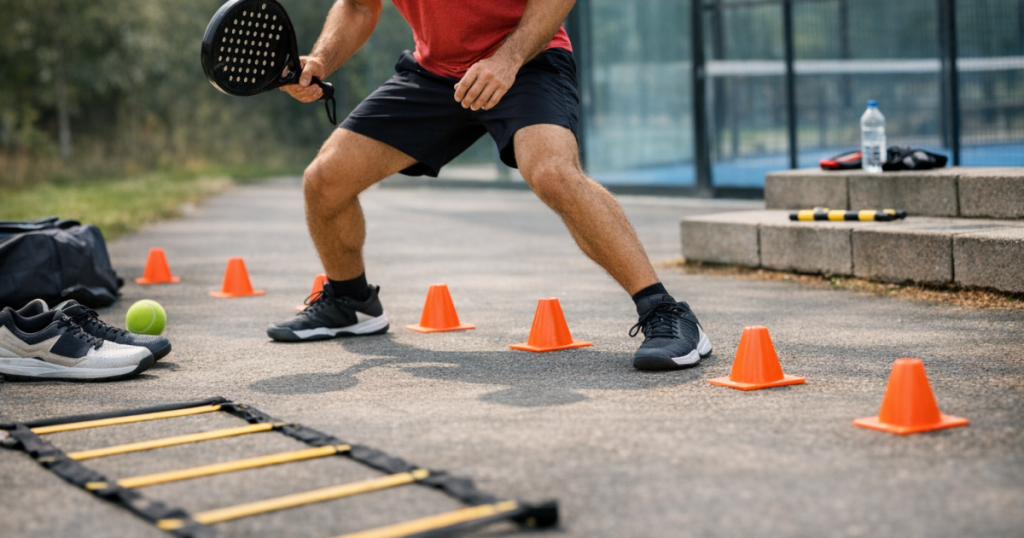
- Mark a centre point with a towel, cone or water bottle.
- Stand behind it in your ready position.
- Split step, then take one quick step to the right and freeze.
- Check that your outside foot is stable and your shoulders are not leaning too far over your toes.
- Return to the centre and repeat to the left, forwards and diagonally backwards.
Freezing at the end is useful because it tells you whether the step actually helped. If you cannot stop under control, the step was probably too long or too rushed.
Practise recovering before you admire the shot
In lessons, coaches often remind new players to recover after striking the ball. Between sessions, you can train that habit without hitting anything. The key is to link every imaginary shot with a movement back to a sensible base position.
Stand as if you are playing from the back half of the court. Shadow a forehand, then take two controlled recovery steps back towards the middle. Shadow a backhand, then recover again. After each recovery, pause in a ready position rather than standing upright.
For early club play, this matters more than looking stylish. Recovering early gives your partner more space, reduces last-second scrambling, and makes it easier to defend the next ball. If you are still working out how lessons fit around your schedule and budget, the guide on group and private padel lessons can help you choose the format that gives you the right level of feedback.
Use a corner-to-centre pattern for defensive movement
Padel defence often starts in the back corners. You may have to move sideways, turn your shoulders, let the ball come off the glass, then recover to the middle. You do not need a glass wall to practise the footwork pattern.
Set up two markers about 1.5–2 metres apart: one as your “corner” and one as your “base”. Start at base. Move diagonally back to the corner using small steps, turn your shoulders as if preparing for a ball after the glass, shadow a compact shot, then recover to base. Repeat on both sides.
Keep the imaginary swing short. This is a movement drill, not a power drill. If your feet tangle, slow it down and make the turn earlier. Beginners often wait until they are already behind the ball before turning, which makes the shot feel cramped.
Train volley movement without rushing the net
At the net, beginner players often move in straight lines and then get stuck. Good volley movement is more like a small side shuffle followed by a balanced stop. You want to arrive early enough to play the ball in front of your body.
Stand in a ready position and imagine you are one or two steps behind the service line. Split step, shuffle one step right, shadow a compact volley, then recover to the middle. Repeat to the left. Keep your racket hand up if you are holding a racket, but do not swing hard.
A useful check is your sound. Good volley footwork is usually quiet. If your feet are slapping the floor, you may be too upright or landing heavily. If you are practising indoors, choose a safe, non-slip surface with space around you rather than a cramped hallway.
Add a lob recovery drill
Lobs are common in beginner and club padel because they reset the rally. The tricky part is moving backwards without panicking. Avoid backpedalling with your chest facing the net for too long; it can make you unstable and late to turn.
Instead, practise a simple turn-and-run pattern. Start in a ready position, split step, then open your hips and take two or three controlled steps backwards on a diagonal. Pretend the ball has gone over you, turn your shoulders, shadow a defensive shot, then recover forwards.
Use both sides. On one side you may feel smooth; on the other you may feel clumsy. That is normal. Padel movement has many diagonal and rotational patterns, and it takes repetition before both sides feel natural.
Check your shoes and surface before you drill
Footwork work only helps if you can move safely. Avoid practising quick changes of direction on wet decking, loose rugs, polished kitchen floors or uneven paving. If you are using a court-side area, stay clear of players, bags and open gates.
For on-court sessions, shoe grip makes a real difference, especially on artificial turf with sand. If you are unsure what sole type is sensible for local club surfaces, read the guide to choosing padel shoes for sanded courts before putting too much load through quick stops and starts.
A 10-minute routine between coaching sessions
Use this routine once or twice between lessons. It is short enough to repeat, but structured enough to make your next session better.
Minute 1: warm up gently
March on the spot, roll your shoulders, loosen your hips and do a few easy side steps. You should feel ready to move, not stretched to your limit.
Minutes 2–3: split step and first step
Alternate right, left, forward and diagonal-back steps. Land softly and freeze for a moment after each movement.
Minutes 4–5: corner-to-centre defence
Move from base to an imaginary back corner, turn, shadow a compact shot and recover. Keep the steps small and controlled.
Minutes 6–7: volley shuffle
Shuffle right, shadow a volley, recover. Shuffle left, shadow a volley, recover. Stay low and keep your head calm.
Minutes 8–9: lob recovery
Open your hips, move diagonally backwards, turn, shadow the shot and recover forwards. Practise both sides evenly.
Minute 10: note one thing
Write down one movement that felt good and one that felt awkward. Take that into your next coaching session. A clear question helps your coach give more useful feedback than a vague “my movement feels bad”.
What to notice during your next lesson
Between-session work is not about becoming your own coach. It is about arriving with better body awareness. In your next lesson, pay attention to when your feet stop moving. Do you freeze after your own shot? Do you recover too far forward? Do you turn late for the back glass? Do you cross your feet when a side shuffle would be safer?
Ask your coach to watch one specific movement pattern during a drill. For example: “Can you check whether I split step before the opponent hits?” or “Am I recovering to the right place after my backhand?” Specific questions make coaching time more productive.
You can also combine movement with other off-court skills. For example, a serve routine pairs well with simple positioning habits, and the guide on how to improve your padel serve without a court gives you another way to use short practice blocks away from a booking.
Common mistakes to avoid
- Doing too much at once: Ten sharp minutes beats 40 tired minutes with poor balance.
- Training like tennis singles: Padel uses shorter, more compact movements with frequent recovery to shared court positions.
- Forgetting the ready position: Every drill should finish with you balanced and prepared, not upright and relaxed.
- Making the swing the focus: Shadow swings are only there to connect the footwork to a realistic padel action.
- Ignoring the awkward side: Spend a little extra time on the direction that feels less natural, but keep the quality high.
Common questions
Can I practise padel footwork at home without a racket?
Yes. In fact, starting without a racket can help you focus on balance, timing and recovery. Add a racket later if it does not make the movement messy.
How often should beginners do footwork drills?
Once or twice between coaching sessions is enough for most beginners. Short, regular practice is more useful than occasional long sessions that leave you tired or sore.
Do I need cones or training equipment?
No. A towel, water bottle or small marker is enough. The important part is having clear start and recovery points.
Should footwork practice feel like a workout?
It can raise your heart rate, but it should not feel like a fitness test. If your movement quality drops, rest or stop.
What should I ask my coach after practising?
Ask about one pattern at a time, such as your split step timing, recovery position, or movement to the back corner. That keeps the feedback clear and usable.
Why it matters
Better footwork makes padel feel slower. You reach more balls in balance, recover sooner for your partner, and give yourself time to choose a sensible shot instead of reacting late. Keep the drills small, stay patient, and use each coaching session to check whether the habits are transferring into real rallies.