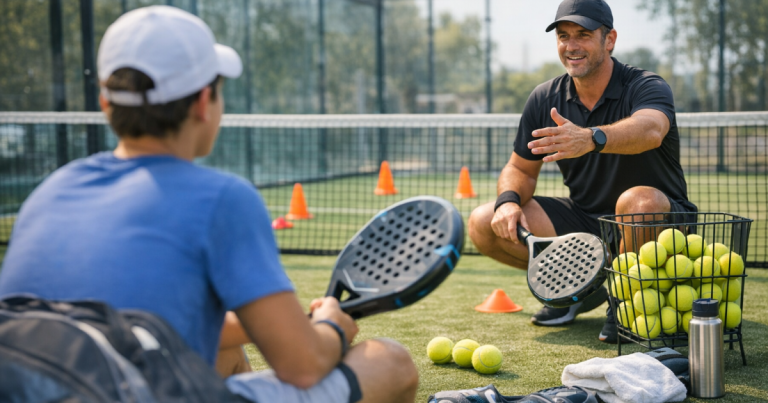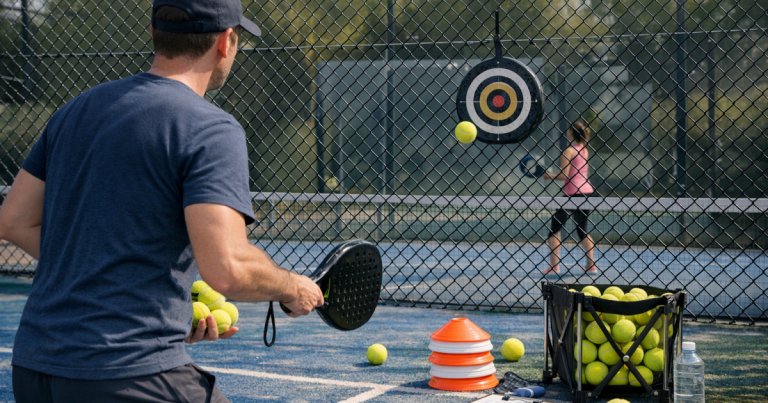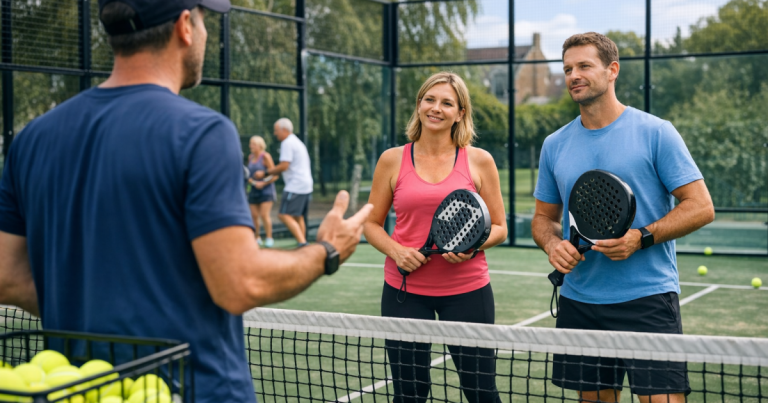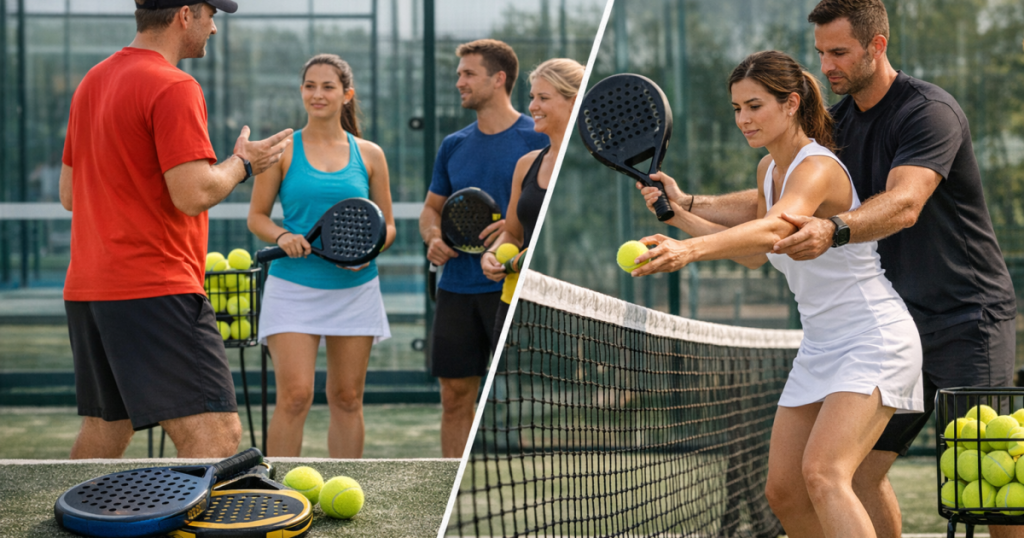
Choosing between group vs private padel lessons usually comes down to how you learn best, what you want to fix, and how quickly you want feedback. Both can help beginners improve, but they feel very different on court: one gives you social repetition and game-like variety, the other gives you focused corrections and a clearer technical plan.
The short version
Choose group lessons if you want a lower-pressure way to learn, meet other players, practise realistic rallies, and build confidence for club nights or box leagues. Choose private lessons if you have a specific problem, feel stuck, want individual feedback, or need help with technique before bad habits settle in.
Many beginners do well with a mix: start with a few group sessions to understand the rhythm of padel, then book an occasional private lesson to tidy up your serve, bandeja, backhand, court positioning or decision-making.
Step 1: Be honest about your current level
Your starting point matters more than your ambition. A complete first-timer may not need one-to-one technical detail straight away. At that stage, learning the serve rules, where to stand, how the glass works and how to keep the ball in play can be easier in a friendly group session.
If you have already played a few times and keep making the same mistake, private coaching becomes more useful. A coach can see whether the problem is your grip, contact point, footwork, swing length, shot choice or positioning. Without that feedback, beginners often practise the same mistake for weeks.
If your first coached session is coming up soon, it is worth reading how to prepare for your first padel coaching session so you turn up with the right expectations and questions.
Step 2: Match the lesson type to your main goal
The group vs private padel lessons choice is easier when you stop asking which is “better” and ask which one solves your next problem.
If your goal is confidence
Group lessons are usually the better starting point. You get used to playing around other people, rotating partners, calling the score, dealing with missed shots and keeping rallies alive. That matters because padel is a doubles game, and confidence often comes from feeling comfortable in normal match situations rather than hitting perfect feeds from a basket.
If your goal is fixing technique
Private lessons are usually stronger. If your serve keeps floating too high, your volleys pop up, or your lob never reaches deep enough, individual coaching lets you work on the root cause. The coach can slow things down, feed repeated balls, change one detail at a time and check whether the correction actually works.
If your goal is joining regular club play
Group lessons are very useful because they mimic the social and tactical side of club padel. You learn to share the court, communicate with a partner and recover after mistakes. Private lessons can still help, but they should support your match readiness rather than replace real doubles practice.
If your goal is faster improvement
Private coaching usually gives faster technical feedback, but it does not automatically make you match-ready. A beginner who only takes private lessons can look tidy in drills but feel lost when four players are moving, lobbing and switching positions. Faster progress often comes from private correction plus group play.
Step 3: Understand what you actually get in each format
A typical group padel lesson gives you variety. You may warm up together, work on one theme, rotate through drills and finish with coached points. The coach has to divide attention between players, so you may not receive constant individual correction. The upside is that you see common beginner mistakes in real time and learn from other people’s questions too.
A private lesson gives you attention. The coach can watch your movement closely, adjust the task to your level and revisit the same shot until it improves. The session can be physically and mentally demanding because there are fewer pauses. For some players, that is exactly what they need. For others, especially nervous beginners, it can feel intense at first.
Neither format is automatically more serious. A well-run beginner group can be structured and detailed. A private lesson can also be relaxed and confidence-building. The difference is how the coach’s time is distributed.
Step 4: Check the practical trade-offs before booking
Before you book, think beyond the headline format. The right session is the one you will attend consistently, enjoy enough to repeat, and use in real matches.
- Cost per player: Group lessons usually cost less per person because court and coaching time are shared. Private lessons cost more per session, but the feedback is more concentrated.
- Attention from the coach: Private sessions give the most direct feedback. Group sessions give less individual attention but more interaction with other players.
- Social benefit: Group coaching can help you meet players at a similar level, which is valuable if you are new to a club or looking for playing partners.
- Pressure level: Some beginners feel safer learning alongside others. Others prefer private coaching because they are not comparing themselves with a group.
- Match realism: Group lessons often create more realistic doubles situations. Private lessons are better for isolating and correcting specific skills.
- Consistency: A weekly group lesson can build routine. A monthly private lesson can act as a useful check-up between matches and social games.
Step 5: Look at the coach-to-player ratio
Not all group lessons are equal. A session with four players can still offer plenty of feedback. A much larger group may be fun and social, but you could spend more time waiting than hitting. Ask how many players are normally on court and whether the group is split by level.
For beginners, similar ability matters. If the level is too high, you may rush shots and lose confidence. If the level is too low, you may not be challenged. A good beginner group should give you enough success to build rhythm, with just enough difficulty to make you improve.
Private lessons have their own ratio question too. Some clubs offer semi-private coaching for two players. This can be a good middle ground if you have a regular partner. You still get targeted feedback, but you can practise doubles patterns, communication and movement together.
Step 6: Use examples from real beginner situations
If you are a complete beginner with one or two games behind you, start with a beginner group course or social coaching session. Your main job is to understand the court, scoring, basic serve, walls and positioning. If the rules still feel fuzzy, take a few minutes to refresh the basic padel rules before your next lesson.
If you are comfortable rallying but keep losing points at the net, a private lesson may help. The coach can look at your ready position, volley contact, racket preparation and whether you are standing too close to the net or too deep.
If you and a friend want to enter club games together, a shared private lesson can be useful. Ask the coach to work on serve-and-return patterns, when to move forwards, who takes the middle ball and how to recover after a lob.
If you feel nervous about playing with strangers, group lessons are often the better long-term answer, even if private lessons feel safer at first. Padel is social by design. The sooner you get used to different partners and opponents, the easier club play becomes.
Step 7: Ask better questions before you book
A short message to the coach or club can save you from booking the wrong session. You do not need a long list, but a few clear questions help.
- Is the session suitable for complete beginners, improvers or mixed levels?
- How many players are usually in the group?
- Will the session include match play or mostly drills?
- Can the coach help with a specific issue, such as serving, lobs or net play?
- Do players rotate partners during the session?
- Is equipment available to borrow if you are still new?
The answers tell you whether the lesson matches your needs. They also show whether the session has a plan, rather than simply filling a court for an hour.
Step 8: Build a simple learning plan
You do not need to commit to one format forever. A sensible beginner plan might look like this: group lessons for the first few weeks, regular social games to practise under pressure, then a private lesson when a repeated issue appears.
After that, use private lessons as tune-ups. For example, book one when your serve is holding back your games, when you cannot control lobs, or when you feel unsure about your role at the net. Use group lessons when you want more rally practice, match habits and partner rotation.
As you improve, positioning becomes one of the biggest differences between casual hitting and proper padel. If you are starting to play regularly with the same person, read up on how to rotate positions with your partner so lessons transfer into better doubles decisions.
Questions people ask
Are private padel lessons worth it for complete beginners?
They can be, but they are not always necessary straight away. If you are brand new, a group beginner session may give you enough structure. Private lessons become more worthwhile when you want to fix specific technique or gain confidence before joining games.
How many group lessons should I take before playing matches?
You do not need to wait until you feel polished. Once you understand the serve, scoring, basic positioning and how the walls can be used, try low-pressure social games. Match experience will show you what to work on next.
Is a semi-private lesson better than a group lesson?
It depends on your goal. Semi-private coaching is excellent if you have a regular partner or want more feedback than a group allows. Group lessons are better for meeting players and practising with different styles.
What should I ask a coach to focus on in a private lesson?
Pick one or two problems, not everything. Good beginner topics include serve consistency, return position, volley control, lobs, movement after your shot and when to move to the net.
Will group lessons help if I am shy or nervous?
Yes, provided the group is beginner-friendly. A supportive group can make padel feel less intimidating because everyone is learning, missing shots and improving together.
Final thoughts
There is no single correct answer. Group lessons help you become comfortable in the real environment of padel: doubles, rotation, communication and varied rallies. Private lessons help you understand what you personally need to change and give you clearer technical feedback.
If you are unsure, start with the format that removes the biggest barrier. If you need confidence and playing partners, choose a group. If you feel stuck or want precise correction, choose private coaching. The best beginners usually do not choose one forever; they use both at the right moments.