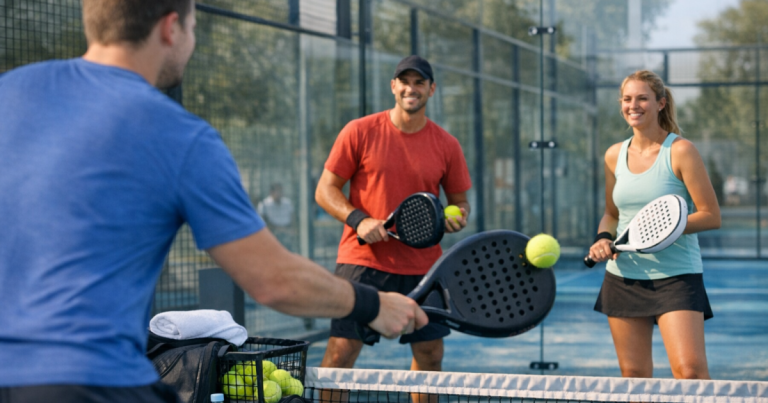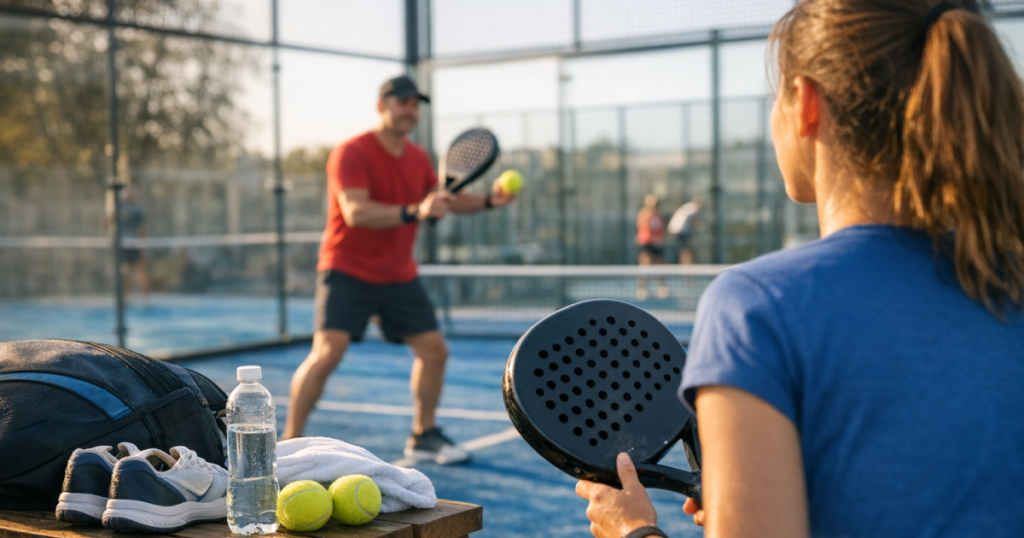
Padel looks fast from the outside, but the first steps are usually more welcoming than people expect. You can learn padel as a beginner without having a tennis background, elite fitness, or perfect technique from day one.
The honest answer is that padel is easy to start and harder to master. Most first-timers can rally, serve and enjoy a social game quickly, but learning when to use the glass, where to stand, and how to make fewer mistakes takes regular court time.
At a glance
- Padel is not hard to try because the court is smaller than a tennis court, the serve is underarm, and doubles play gives you a partner to share the work.
- The hardest early habits are controlling power, understanding rebounds, and moving as a pair rather than chasing every ball alone.
- A first session should focus on keeping the ball in play, learning the basic scoring pattern, and getting used to the walls.
- After a few games, progress comes from simple positioning, calmer shot choices, and better communication with your partner.
- Kit matters, but it should not distract you early on. Comfortable court shoes, a suitable racket and fresh balls are enough to get started.
Why padel feels easier than many racket sports at first
Padel gives new players a lot of help. The court is enclosed, so some balls that would be gone in tennis remain playable. The racket is short and solid, which makes basic contact feel less intimidating than using a long-strung racket. The underarm serve also removes one of the most difficult barriers found in tennis.
The doubles format helps too. You are rarely covering the whole court by yourself, and you can learn by watching your partner between points. In a friendly club setting, this makes the first few games feel more like problem-solving than a test of athletic ability.
That said, padel is not simply “mini tennis”. The walls change the rhythm completely. A ball can pass you, hit the back glass and come back into a playable position. At first, many beginners either rush the ball too early or let it drop too far behind them. Getting comfortable with that timing is one of the main learning curves.
If you want a grounding in the court shape, common shots and early tactics, start with the padel court layout and beginner shots before your first match. It makes the lines, positions and basic patterns much easier to understand once you are standing on court.
What usually feels tricky in the first few sessions
The first challenge is not hitting the ball hard. It is learning that padel rewards control. New players often swing too big, aim too low, or try to finish points too early. The better beginner habit is to play with margin: clear the net safely, aim away from the side glass until you understand the angle, and make the opponents hit one more ball.
The second challenge is footwork. Because the court is compact, beginners sometimes stand still and reach with the arm. Small adjustment steps make a big difference. Being balanced at contact helps you guide the ball rather than slap at it.
The third challenge is communication. Padel is a shared court game, so silence creates confusion. Simple calls such as “mine”, “yours”, “leave” and “back” prevent clashes and help both players move together. You do not need complicated tactics; you just need enough talking to avoid two people making different decisions at the same time.
The fourth challenge is the glass. The rebound is not random, but it feels that way at first. The ball speed, angle and spin all affect where it comes back. A good beginner rule is to give yourself more space than you think you need and watch the ball after it hits the glass rather than turning away too soon.
A first-timer’s roadmap
Before you book a court
Choose a beginner-friendly session if your local club offers one. Introductory group sessions are useful because everyone is learning the same basics, and the pace is usually calmer than joining an established game. If you are booking privately with friends, try to include at least one person who has played before, even if they are still fairly new.
Wear comfortable sports clothing and proper court shoes if you have them. Running shoes can feel unstable for side-to-side movement, so be careful with sharp changes of direction. You do not need to own a racket immediately; many clubs can lend or hire one for early sessions.
During your first 20 minutes
Start with gentle cooperative rallies rather than a full match. Hit forehands and backhands from the middle of the court, then try a few balls after the back glass. Keep the aim simple: over the net, inside the court, not too close to the glass. This gives you a feel for the bounce without the pressure of scoring.
Then practise the serve. Padel serves are underarm and must be played after a bounce, which makes them more approachable than overhead serving. Do not worry about pace. A slow, reliable serve that starts the point is much more useful than a fast serve that misses.
Your first match
Use normal scoring if someone can guide the group, but keep the atmosphere relaxed. The main goal is to understand when points start, when they end, and which rebounds are legal. If the rules feel fuzzy, pause and clarify rather than arguing through the point.
Players with a tennis background often bring helpful hand-eye coordination, but they also bring habits that do not always transfer. The serve, use of walls, and court positioning are different enough to deserve their own explanation. For a clear side-by-side view, read the key differences between padel rules and tennis rules.
Your first month
Once you have played a few times, shift your focus from “can I hit the ball?” to “can I make the rally easier for my team?” That means recovering to a sensible position, choosing safer targets, and learning when to attack.
A simple weekly pattern works well. Spend one session playing casual points, one session doing light practice with a friend, and one session joining a beginner mix-in if available. You do not need intense training; you need repeated exposure to the same situations until they feel less rushed.
This is also the point where you can learn padel as a beginner with more intention. Notice the mistakes that happen most often. Are you missing returns? Getting trapped at the back? Hitting the side glass by accident? Losing track of who should take middle balls? Pick one theme per session rather than trying to fix everything.
The core skills that make padel feel easier
Keep the racket preparation short
Big swings create late contact and unpredictable direction. A shorter backswing helps you meet the ball in front of your body and guide it. Think compact, calm and repeatable. That is especially useful on faster exchanges near the net.
Use height when you are under pressure
When you are rushed at the back of the court, a higher ball can buy time. Beginners often try to thread low winners from difficult positions, but a controlled lob or deeper defensive shot is usually smarter. It lets your team reset instead of giving away a cheap point.
Stand with your partner, not as two separate players
If one player goes forward and the other stays deep without a reason, gaps open up. As a beginner pair, move roughly together: both back when defending, both ready to move forward when you have created time. You do not have to be perfectly synchronised, but you should avoid leaving one person isolated.
Respect the middle
Many beginner points are lost because both players leave the middle ball or both swing at it. Decide before the match who takes the middle on forehand-side and backhand-side balls. Then keep talking. Clear ownership matters more than perfect technique.
How much fitness do you need?
You do not need to be extremely fit to start padel, but you do need to manage short bursts of movement. The court is 20 metres by 10 metres, and doubles play reduces the amount each person covers. However, rallies can involve quick stops, turns and side steps.
If you are returning to sport after a break, ease in with shorter sessions and longer rests between games. Warm up your shoulders, calves and hips before playing, and build up gradually. Padel is social and accessible, but it is still a stop-start court sport, so your body will appreciate a sensible pace.
Common beginner mistakes to avoid
- Trying to win every ball: Early padel is mostly about not losing the point too soon. Consistency beats dramatic shot-making.
- Ignoring the glass: If the ball is going to rebound cleanly, let it come back rather than rushing into a cramped contact.
- Standing too close to the back wall: Give yourself room to move backwards and forwards as the ball rebounds.
- Over-hitting volleys: A firm, placed volley is often better than a full-power swing.
- Playing in silence: Talk before, during and after points. It removes uncertainty and builds confidence quickly.
- Changing gear too soon: A different racket will not fix rushed decisions, poor spacing or unclear communication.
When should you think about your own racket?
There is no rush to buy a racket before your first game. Borrowing or hiring one gives you time to understand what feels comfortable. Once you are playing regularly, your own racket can make sessions feel more familiar because the weight, grip and response are consistent.
For most early-stage players, comfort and control are more useful than maximum power. A forgiving shape and manageable weight will usually help you build confidence while your technique develops. If you are reaching that stage, the guide on choosing a padel racket for your first season explains the main decisions without making the process more complicated than it needs to be.
How long does it take to feel comfortable?
Many people feel comfortable enough to enjoy a social game after one or two sessions. Feeling genuinely settled with the glass, positioning and shot selection usually takes longer. A realistic beginner timeline looks something like this:
- First session: You learn the serve, basic scoring, simple rallies and how the court feels.
- After three to five sessions: You start reading rebounds better and understand where to stand more often.
- After a month of regular play: You make fewer rushed errors and begin using simple tactics with your partner.
- After a few months: You recognise patterns, defend more calmly and choose safer attacking moments.
Progress is not perfectly linear. Some sessions will feel messy, especially when you face opponents who use the walls well or change pace. That is normal. The important sign is not whether you win every game, but whether you understand more of what happened than you did the week before.
Things readers ask
Can I play padel if I have never played tennis?
Yes. Tennis experience can help with timing, but it is not required. Many beginners come from football, squash, badminton, gym training or no regular sport at all.
Is padel harder than tennis?
Padel is usually easier to start because of the underarm serve, smaller court and doubles format. Tennis can feel more technically demanding at the very beginning, especially on the serve.
What should I focus on in my first match?
Keep the ball in play, call clearly with your partner, and avoid swinging too hard. A steady rally teaches you more than chasing low-percentage winners.
Do I need lessons straight away?
No, but a beginner lesson can speed things up if you feel lost with the glass, positioning or scoring. Casual play is fine as long as you are learning good habits.
How often should a beginner play?
Once a week is enough to build familiarity. Twice a week helps you improve faster, provided you recover well and keep sessions enjoyable.
Final thoughts
Padel is not hard to learn in the sense that your first game should feel impossible. The basics are friendly, the rallies start quickly, and the social side makes it easier to keep coming back. The deeper challenge is learning patience: letting the glass help, moving with your partner, and choosing the shot that keeps your team in the point.
If you treat the first few weeks as a roadmap rather than a test, padel becomes much less intimidating. Start with simple rules, build reliable contact, add positioning, and only then worry about more advanced shots. That steady approach is usually the quickest route from nervous first-timer to regular club player.