A racket can feel easy in the shop and strangely awkward once the ball starts moving. One reason is padel racket balance: where the racket’s weight feels concentrated as you swing, block, volley and defend. For beginners, this can matter as much as the headline weight because it changes how quickly the racket moves, how stable it feels on contact, and how tiring it becomes during a full club session.
In brief
- Head-light rackets usually feel quicker to move, easier to manoeuvre at the net and more forgiving when you are still learning timing.
- Head-heavy rackets can feel more solid and powerful, but may be harder to control if your technique is not yet settled.
- Even-balance rackets sit between the two and are often a sensible middle ground for early-stage club players.
- The printed weight in grams is only part of the story. A lighter racket can still feel demanding if more of its weight sits towards the head.
For most beginners, the aim is not to find the most powerful racket possible. It is to find a racket you can swing repeatedly without rushing, gripping too tightly or arriving late to the ball. Once that feels comfortable, power becomes much easier to develop through better contact and movement.
What racket balance actually means
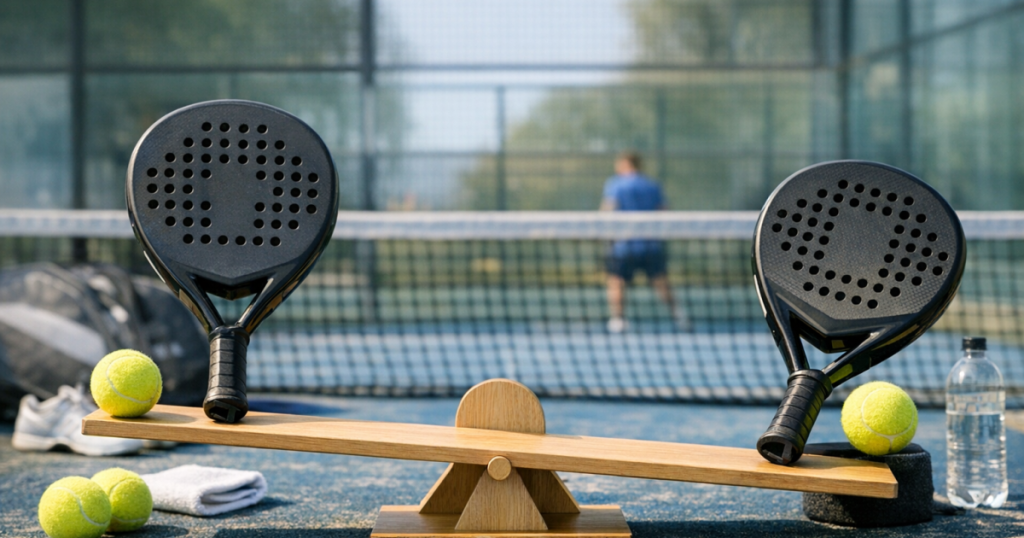
Padel racket balance describes the point at which the racket feels evenly supported. If the balance point is nearer the handle, the racket is generally described as head-light. If it is nearer the top of the racket face, it is head-heavy. If it sits around the middle, it is usually called even balance.
This is not the same as total racket weight. Two rackets can both weigh around the same in grams but feel very different in play. One may whip through the air easily, while the other feels more substantial when you prepare for an overhead or block a fast ball.
Balance is affected by several things working together: the racket’s shape, the distribution of material in the frame, the size of the sweet spot, the grip setup and any accessories you add, such as an overgrip or frame protector. That is why simply reading the listed weight is not enough. If you are still unsure how balance and weight interact, it is worth reading more about light vs heavy padel rackets before buying your first serious racket.
How a head-light racket feels on court
A head-light racket carries more of its weight towards the hand. For a beginner, the main benefit is manoeuvrability. It tends to feel easier to lift, turn and reposition quickly, which helps when rallies become messy and you do not have perfect preparation time.
This can be especially useful in three common beginner situations. First, when defending near the back glass, you often need to make small late adjustments as the ball rebounds. A racket that feels quick in the hand can make those adjustments less stressful. Second, at the net, you need short reactions rather than big swings. A head-light feel can help with compact volleys and blocks. Third, when you are learning basic positioning, you will sometimes be slightly off balance. A more manoeuvrable racket is usually easier to recover with.
The trade-off is that a very head-light racket may feel less solid when you meet a fast ball or when you try to hit a firm bandeja, vibora or smash. Beginners sometimes respond by swinging harder, which can reduce control. The better approach is to keep the swing compact and focus on clean contact rather than trying to force extra pace.
How a head-heavy racket feels on court
A head-heavy racket carries more of its mass towards the top of the face. When timing is good, this can create a heavier feeling through the ball. Players often associate this with power, stability and a more forceful overhead game.
For beginners, the appeal is understandable. A head-heavy racket can feel reassuring on simple feeds and can make the ball travel well when you catch it cleanly. However, padel is full of awkward balls: low rebounds, half-volleys, quick body shots and lobs that force you to move backwards. In those moments, the extra weight towards the head can make the racket feel slower to prepare.
The most common issue is lateness. If the racket head drops or arrives after the ideal contact point, you may start pushing the ball, scooping it upwards or steering with the wrist. That does not mean head-heavy rackets are wrong for beginners, but they are less forgiving if your footwork, preparation and swing length are still inconsistent.
They may suit newer players who are physically comfortable with a slightly more demanding feel, already make early contact, and prefer a stable racket for controlled attacking shots. They are usually less ideal for someone who gets arm fatigue quickly, tends to grip the racket tightly, or struggles to react in faster exchanges.
Even balance: the quiet middle ground
Even-balance rackets do not get as much attention as the head-light versus head-heavy debate, but they often make a lot of sense for improving beginners. They aim to provide enough manoeuvrability for defence and net play without feeling too light through contact.
If you are moving from occasional hire rackets into regular club sessions, this middle-ground feel can be reassuring. You do not have to commit to a very power-focused setup, and you do not have to choose the quickest possible racket if you prefer a little more substance in the hand.
For many early-stage players, the best racket is not the one that produces the biggest shot in a ten-minute test. It is the one that still feels controllable during the final games of a busy session, when your timing and footwork are less tidy.
Balance, shape and weight work together
Racket balance should not be judged in isolation. Shape has a big influence on how the racket behaves. Round rackets are often associated with control and a more accessible sweet spot. Teardrop rackets usually sit between control and power. Diamond-shaped rackets are often more attack-focused and can feel more demanding, depending on the model.
That does not mean every round racket is automatically easy, or every diamond racket is unsuitable. Construction, foam feel and overall weight still matter. But for a beginner, a round or moderate teardrop shape with a manageable balance is usually easier to live with than a very top-heavy attacking racket.
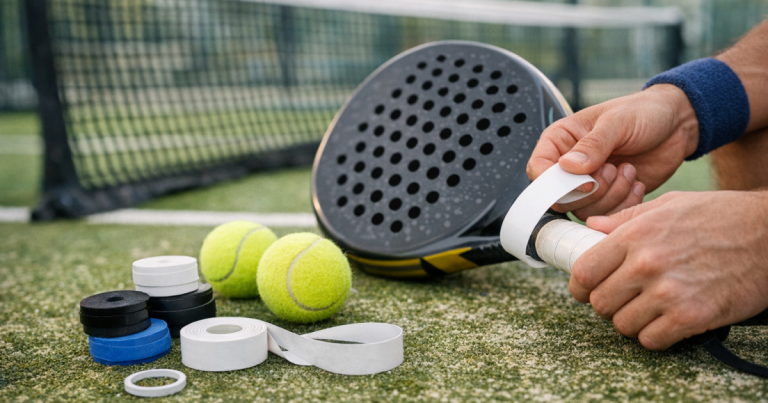
Grip setup can also change the feel. Adding an overgrip puts a small amount of extra weight near your hand, which can make the racket feel fractionally more handle-biased. A protector near the top of the frame can do the opposite. These changes are not magic fixes, but they explain why your racket may feel slightly different after small adjustments.
Simple ways to assess balance before you commit
You do not need lab equipment to get a useful impression. Start by holding the racket as you would during a normal rally. Make a few short volley movements, then a slow preparation for a bandeja or overhead. The question is not whether the racket feels impressive for one big swing. It is whether you can control the head of the racket smoothly and repeatedly.
If possible, try the racket on court rather than only in a shop or clubhouse. A few minutes of real padel tells you more than dry swings. Pay attention to these signs:
- If the racket feels easy to reposition during volleys and blocks, the balance is probably manageable for your current level.
- If the head keeps dropping during preparation, the racket may be too head-heavy or too heavy overall.
- If contact feels unstable unless you swing hard, the racket may be too light, too head-light or simply not suited to your timing.
- If your hand, forearm or shoulder feels tired unusually quickly, the racket may be asking too much of your current technique and conditioning.
- If you play better when you shorten your swing, that is usually a good sign for beginner padel because compact strokes are easier to repeat.
Hiring or borrowing can be a sensible step before buying, especially if you are still working out what feels natural. If you are deciding whether to use club equipment for a while or invest in your own, the guide to club racket hire vs buying for your first sessions explains the trade-off clearly.
Common beginner scenarios
You are late on volleys
If fast net exchanges feel rushed, a head-light or even-balance racket will usually be easier to manage than a strongly head-heavy one. It can help you keep the racket up and react with shorter movements.
You want more power
A head-heavy racket can help some players generate a heavier ball, but it will not fix poor timing. If your shots lack depth, check your contact point, foot position and follow-through before assuming you need a more powerful racket.
You mostly defend from the back
Beginners often spend plenty of time near the back glass. A more manoeuvrable racket can make lobs, low pickups and rebounds easier while you learn the rhythm of the court.
You play long club sessions
A racket that feels fine for 15 minutes may feel tiring after 90 minutes. If you regularly play matches, coaching and social games back to back, comfort and repeatability should outweigh the desire for maximum power.
Different views you will hear at clubs
One common view is that beginners should always choose a light, head-light racket. There is truth in that: easy handling helps new players build confidence. But it is not a universal rule. Some players dislike a racket that feels too fluttery and prefer a little more mass through the ball.
Another view is that stronger players should use head-heavy rackets. Strength helps, but padel is not just about muscle. A player with good timing and compact technique can use a heavier-feeling racket well; a stronger player with late preparation may still struggle.
The most useful approach is to match the racket to the way you actually play now, not the player you hope to become in six months. You can always move towards a more attacking feel later, once your contact, footwork and decision-making are more reliable.
Balance also affects how you combine with a partner. If you are still learning when to cover the middle, when to switch and when to hold position, a manageable racket can make those small reactions easier. For the tactical side, see the guide on how to rotate positions with your partner in padel.
Questions people ask
Is head-light better for beginners?
Often, yes. A head-light racket is usually easier to move quickly, which helps beginners with volleys, rebounds and late adjustments. It is not the only suitable option, but it is a safe starting point for many new players.
Does head-heavy always mean more power?
No. Head-heavy rackets can feel more powerful when timing is good, but power also depends on technique, contact point, movement and confidence. Poor timing can make a head-heavy racket feel harder, not stronger.
Can I change the balance of my racket?
Only slightly. An extra overgrip adds weight near the handle, while a frame protector adds weight nearer the head. These changes can affect feel, but they will not completely transform the racket.
Should I choose balance or weight first?
Consider both together. Total weight tells you how much mass you are holding, while balance tells you where that mass feels concentrated. A sensible beginner racket needs both to feel manageable.
How do I know if my racket is too head-heavy?
Signs include late preparation, a dropping racket head, tiredness during longer games and difficulty reacting at the net. If your swing becomes rushed or wristy, the balance may be too demanding.
Why it matters
The right balance helps you play calmer padel. You prepare earlier, keep your swing shorter, react better at the net and defend with less panic from the back glass. For beginners, those benefits usually matter more than chasing the most powerful racket on the rack.
If you are unsure, start with a racket that feels easy to manoeuvre and stable enough on simple shots. For many players, that means head-light or even balance rather than strongly head-heavy. As your technique improves, you will have a clearer sense of whether you need more weight towards the head or simply more practice with the racket you already have.