Low serves can make beginners feel cramped: the ball stays below the knees, the swing gets rushed, and the return either pops up or drops into the net. The most useful padel return drills for this problem are not flashy; they train a lower ready position, a shorter backswing, and a simple target so you can make the server play one more ball.
Before you start, warm up properly and keep the first few minutes gentle. Low return work asks more of your knees, ankles and hips than casual rallying, so build the intensity gradually rather than trying to win the drill straight away.
The short version
To return low serves more reliably, think less about power and more about timing. Your job is to get your body low early, meet the ball slightly in front, keep the racket face controlled, and send the return deep enough that the serving pair cannot attack easily.
- Start lower than usual: bend from the knees and hips, not by folding at the waist.
- Use a compact swing: a long backswing is the main reason beginners mistime low serves.
- Step towards the ball: even a small step helps you avoid reaching with only your arm.
- Aim safely: deep cross-court or through the middle is usually better than a low-percentage winner.
- Recover immediately: after the return, move into a balanced defensive position instead of watching the shot.
Why low serves cause so many return mistakes
A low serve gives you less space under the ball. If you stand tall, your racket often travels down towards contact, which sends the ball into the net. If you panic and scoop upwards, the return floats high and gives the serving team an easy first volley.
The serve also arrives after the bounce, so the height can vary depending on pace, spin, court surface and whether the ball skids. In beginner club games, many low serves are not especially fast, but they feel awkward because they arrive close to the feet or body.
It helps to understand the serving rules too. A legal padel serve must be underarm after a bounce, and the ball must be struck below waist height. If you are unsure what is allowed, this guide to how to serve legally in padel explains the basics clearly. Knowing what a legal serve looks like makes return practice more realistic.
Set up the return position first
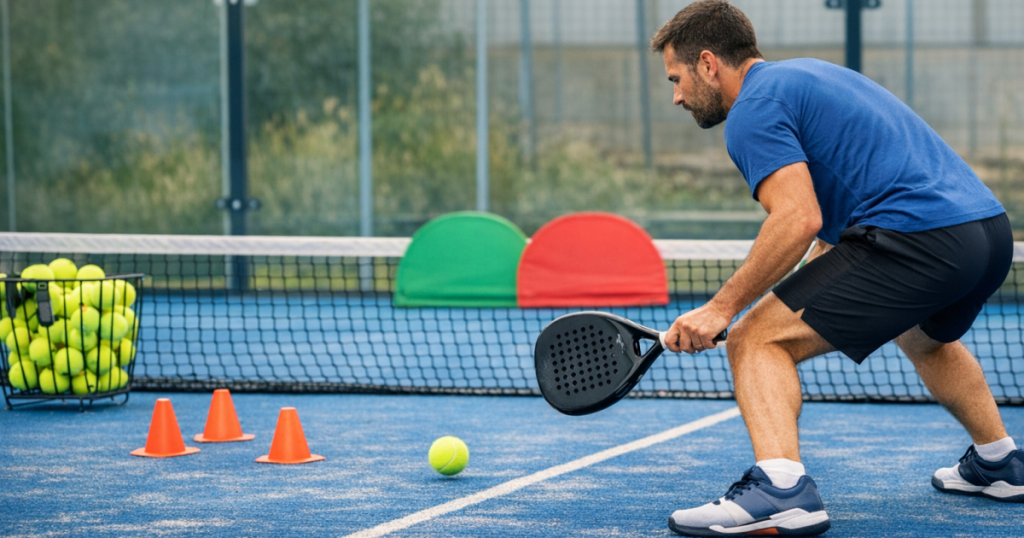
Before adding drills, fix the starting shape. Stand just behind the service line unless the server is very slow or very deep. Keep your feet a little wider than shoulder width, with your weight on the balls of your feet. Your racket should be in front of your body, not hanging by your side.
For low serves, your ready position should feel slightly lower than your normal rally stance. You are not squatting, but you should be able to push left, right or forwards without first having to drop your body. If your first movement is down, you are already late.
Simple self-check
- Can you see the server, the bounce and your target without turning your head too much?
- Is your racket already in front of your chest or waist area?
- Are your knees soft enough that you could move on the next beat?
- Can you take one small step before contact rather than reaching from a static position?
Drill 1: drop, block and lift
This is the best starting drill because it removes the pressure of a full serve. You need one feeder and one returner. The feeder stands inside the service box and gently drops or tosses balls so they bounce low in front of the returner. The returner practises a short block with a controlled lift over the net.
How to do it
- Start in your return position with the racket in front.
- The feeder sends a soft low ball towards your forehand side.
- Step towards the ball with a small, balanced step.
- Keep the backswing short and meet the ball slightly in front of your lead foot.
- Finish with the racket pointing towards a safe target, not high above your shoulder.
- Repeat 10 times on the forehand, then 10 times on the backhand.
The aim is not to hit hard. You are learning the feeling of getting under control before the ball drops too low. If the return keeps hitting the net, lower your body earlier and open the racket face slightly. If the ball floats too high, shorten the follow-through and reduce the scoop.
Drill 2: low serve to deep cross-court
Once the contact feels cleaner, move to a more realistic serve. The server stands in the normal serving position and hits gentle low serves to one side. The returner aims deep cross-court, ideally towards the back third of the court.
Deep cross-court is a sensible beginner target because it gives you more court to work with and keeps the ball away from the net player’s easiest attacking zone. It also teaches you not to overreact to a low ball by trying to win the point immediately.
How to score it
- One point for any legal return into court.
- Two points for a return that lands deep cross-court.
- No points for returns that pop up short through the middle.
- Play to 15 points, then switch roles.
This scoring keeps the drill friendly but useful. If both players are beginners, keep the serve pace at around match warm-up level. The quality of the return matters more than making the drill look competitive.
Drill 3: split-step and step-in timing
Many low return errors begin before the swing. The returner is either flat-footed or moving too early. A small split-step as the server hits helps you react without guessing. If this movement feels new, spend time on dedicated padel split-step drills so the habit carries into match situations.
For this drill, the server alternates low serves to the forehand and backhand. The returner must split-step as the server strikes the ball, then take one small step towards the serve before contact.
What to focus on
- Land the split-step as the server makes contact, not after the ball has crossed the net.
- Push from the outside foot when moving sideways.
- Keep the first step small enough that you remain balanced.
- Do not let the racket drop behind your body.
If you are consistently late, simplify the task. Ask the server to send every ball to the same side for two minutes, then alternate sides only after the timing improves. Good return movement is built in layers.
Drill 4: body serve escape
Low serves into the body are awkward because there is no clear swing path. Beginners often jam themselves, pull away, or flick the wrist. The fix is to create space with footwork before the ball reaches you.
Set up with the server aiming gently at the returner’s hip or inside foot. The returner chooses one of two escapes: move slightly back and across to create a forehand, or step out to make room for a backhand. The return target is not aggressive; just get the ball deep and playable.
Step-by-step
- Begin in a low, balanced return stance.
- Call “forehand” or “backhand” as early as possible once you read the serve.
- Move your feet first, then set the racket.
- Use a compact swing through the ball.
- Recover to the middle of your defensive half after the return.
A useful rule: if the ball is too close to your body, do not try to solve it with your wrist. Move your feet to make a clearer contact point. Even a half step can turn a cramped jab into a controlled return.
Drill 5: glass or no glass decision
Not every low serve should be taken straight after the bounce. Some serves are better left to come off the side or back glass, depending on angle, speed and your comfort level. Beginners often rush because they think using the glass is advanced, but learning the decision early prevents panic.
In this drill, the server mixes two serves: one low serve that should be returned before the glass, and one wider serve that can be allowed to rebound. The returner must call “early” or “glass” before playing the ball.
Decision cues
- Take it early when the serve is slow, central, or sitting in front of you.
- Use the glass when the ball is wide, angled, or pulling you off balance.
- Avoid guessing by watching the serve bounce before making your final movement.
- Keep the target simple after using the glass; height and depth matter more than pace.
The purpose is to make a clear decision, not a perfect shot. In real club games, a calm choice is often enough to stop the serving team from taking control immediately.
Drill 6: two returns, then play the point
Once the technique is steady, add pressure without making the drill chaotic. The server gets two low serves. The first is always fed to the returner’s forehand, the second to the backhand. After the second return, the point becomes live and both pairs play normally.
This bridges the gap between basket practice and match play. You get repetition, but you also have to recover, read the next ball and make normal decisions. Keep the score simple: the returner wins a bonus point if both returns land in, then the rally point is played as usual.
Common faults and quick fixes
The return keeps going into the net
You are probably too upright or contacting the ball too late. Start lower, step in earlier and meet the ball slightly in front. Do not try to rescue the shot with a big upward scoop.
The return floats high
Your racket face may be too open, or your swing path may be too steep. Think “block and guide” rather than “lift and lob”. A little height is fine, but a slow short ball invites the volley player in.
You feel jammed by body serves
Create space with your feet before swinging. Practise the body serve escape drill slowly until the movement feels natural. If your elbow is trapped against your side, the contact will be unreliable.
You return well in drills but not matches
Add scoring, targets and recovery to your practice. Match pressure changes your timing, so the drill needs a small consequence. You can also ask a coach to watch one return game and identify whether the issue is stance, timing or decision-making. These are good points to raise if you are thinking about booking a padel coach.
How to build a 20-minute return session
You do not need a long session to improve low-serve returns. A focused 20 minutes before or after a club game can be enough if you avoid turning every ball into a point.
- Minutes 1-4: drop, block and lift on both sides.
- Minutes 5-8: low serve to deep cross-court, one side at a time.
- Minutes 9-12: split-step and step-in timing with alternating serves.
- Minutes 13-16: body serve escape, focusing on footwork before swing.
- Minutes 17-20: two returns, then play the point.
If you only have one court and four players, rotate every five serves. One player serves, one returns, and the other two stand as target or rally players. Keep the feed safe and realistic rather than trying to blast serves past each other.
Main points
Low serves are easier to handle when you prepare early and keep the return simple. Build the habit of a lower ready position, a small split-step, a compact swing and a sensible target. The best padel return drills for beginners turn those habits into automatic reactions, so you stop feeling rushed when the serve stays low.
For most club players, the goal is not a spectacular return winner. It is a clean, deep ball that stops the serving pair from attacking the first volley. Practise that consistently and your return games will feel calmer very quickly.
Common questions
Should I slice low serves back?
A small amount of slice can help experienced players keep the ball low, but beginners should not rely on it too early. First, learn to make clean contact with a compact block. Add more spin once the basic return is consistent.
Is it better to lob a low serve?
A lob can work if the serve gives you time and the opponents rush the net, but it is harder from a very low contact point. Use it selectively. A deep, controlled return is usually the safer first option.
Where should I aim if I am under pressure?
Aim deep through the middle or deep cross-court. Avoid going close to the side fence or trying to pass the net player from a cramped position. Under pressure, a boring target is often the smart target.
How often should beginners practise return drills?
Short, regular practice is better than one long session. Ten to 20 minutes once or twice a week can make a noticeable difference, especially if you repeat the same targets and track how many returns land deep.