The first few rebounds off the rear wall can feel rushed: the ball drops behind you, your feet freeze, and the swing becomes a hopeful scoop. Practising back glass shots in small, repeatable drills teaches you to wait, turn early, and send the ball back with control rather than panic.
The short version
A good rear-wall drill should make the ball predictable enough for you to focus on timing, not survival. Start slowly, repeat the same feed, and measure success by balance and direction rather than power.
- Stand far enough from the rear glass to let the ball rebound into your hitting zone.
- Turn your shoulders as soon as you recognise the ball is going deep.
- Let the ball pass, wait for the rebound, then use a compact swing.
- Aim cross-court or down the middle before trying harder angles.
- Practise in short blocks so your footwork stays sharp.
Give yourself a few minutes to loosen your hips, calves and shoulders before these drills. If you are new to court movement, this guide on how to warm up safely before you play is a useful starting point.
Why the rear wall feels difficult at first
The main challenge is that the ball is still live after it bounces in your court and hits the back glass. Beginners often react as if they must hit it before the wall, so they rush backwards, get too close to the glass, and make contact beside the body. That makes the shot feel cramped and unreliable.
The aim is usually not to hit a winner. Most beginner-friendly back glass shots are defensive resets: a controlled ball back over the net, ideally high enough to buy time and deep enough to stop the opponents attacking easily. Once that feels natural, you can add lobs, lower drives and angled replies.
Set up a simple practice area
You do not need a coach, ball machine or advanced drill plan to start. A court, a few balls and a patient partner are enough. If you are practising alone, some clubs allow gentle self-feeds from the hand, but keep the pace low and avoid chasing balls into the glass.
- Use one side of the court first: start on your forehand side if that feels more comfortable, then repeat on the backhand side.
- Begin around 1–2 metres from the rear glass: adjust from there depending on how high and fast the feed is.
- Pick one target: aim towards the opposite service box or the centre channel, rather than changing target every shot.
- Keep feeds gentle: the goal is clean repetition, not testing your reactions at match speed.
- Use consistent balls: very flat balls can make timing harder because they rebound less clearly.
Drill 1: catch the rebound before you hit it
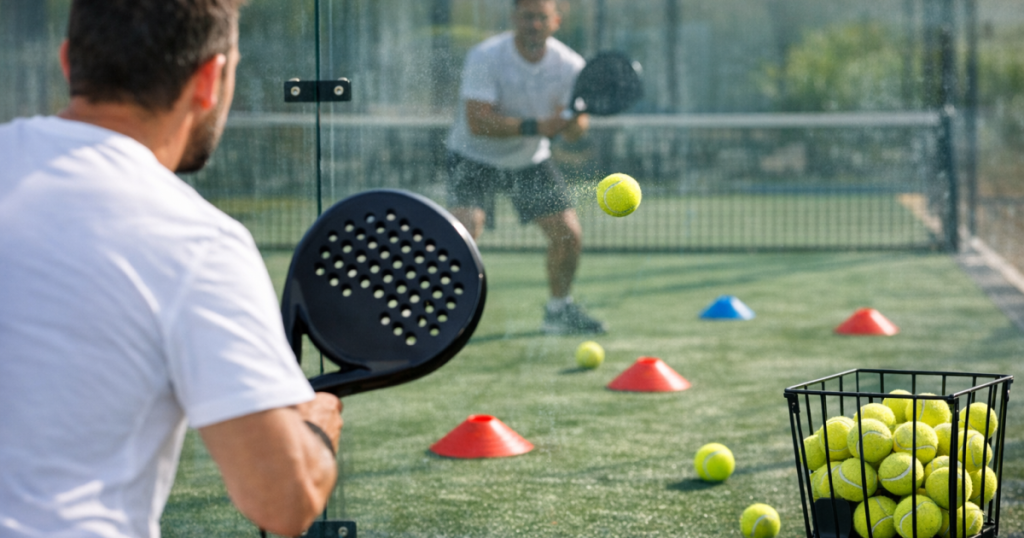
This is the best starting drill if the rear wall makes you feel rushed. Ask a partner to stand near the opposite service line and feed a gentle ball so it bounces in your court, reaches the rear glass, and comes back towards you. Instead of hitting, let it rebound and catch it with your non-racket hand after one bounce off the wall.
How to do it
- Start in a neutral ready position, not right against the glass.
- Call “turn” as soon as you know the ball is going deep.
- Let the ball pass your outside hip.
- Watch it touch the rear glass, then move forwards to catch it calmly.
- Repeat 10 times on one side, then 10 on the other.
This teaches patience. If you keep catching the ball too close to your body, move a little further from the glass. If you have to lunge forwards, you may be starting too far away or the feed may be too soft.
Drill 2: compact swing to the middle
Once the catch drill feels comfortable, add the racket. Use the same feed, but now play the ball back over the net with a short, controlled swing. Aim through the middle of the opponents’ court rather than near the side fence. The middle target gives you more margin and reduces the temptation to overhit.
Key cues
- Turn early and show your side to the net.
- Keep the racket head prepared before the ball reaches the glass.
- Let the rebound come out to you instead of stabbing at it.
- Contact the ball slightly in front of your body after the rebound.
- Finish balanced, with your weight moving gently forwards.
Do three sets of eight balls. Count only the shots that clear the net and land in a sensible area. If you make three mistakes in a row, slow the feed down and return to the catch version for a minute.
Drill 3: cross-court reset
The cross-court reset is useful because it gives you more court to work with. From the right side, a right-handed player will often practise a forehand after the rear glass towards the opposite corner. From the left side, you can repeat the same idea on the backhand or forehand depending on your position.
Keep the target generous. Imagine a large rectangle from the opposite service box towards the back glass. You are not trying to paint the line; you are trying to recover the point and give yourself time to move back into position.
- Feed 12 balls to the same side.
- Play every ball cross-court with medium height.
- After each shot, recover towards your normal defensive position.
- Swap sides and repeat.
- Finish with a short rally where your partner feeds randomly to either side.
Drill 4: turn, wait, lob
A lob from the rear wall is one of the most useful beginner skills in padel. It helps you escape pressure when opponents are at the net. The mistake is trying to lift the ball using only the wrist; a better lob comes from good positioning, soft hands and a smooth upward finish.
Use a slower feed than the reset drill. Let the ball rebound, move into it, and send it high over the opponents’ reach. Aim for depth before height becomes extreme. A lob that lands deep is useful; a very high lob that drops short can invite an easy smash.
Simple scoring game
- Give yourself one point for clearing the net.
- Add one point if the ball lands past the service line.
- Add one point if you finish balanced and recover to position.
- Play to 15 points, then switch sides.
This scoring method keeps the drill focussed on match habits, not just where the ball lands. A balanced recovery matters because the next ball is often the one that decides whether you escape the defensive corner.
Drill 5: serve, return, then rear-wall reply
To make the skill more realistic, add a short sequence. One player serves gently, the receiver returns, and the server or feeder then plays a controlled deep ball so the receiver has to use the rear glass. This links the shot to the kind of pattern beginners see in club games.
If low returns are also causing problems, practise them separately with these return drills for low serves. A steadier return gives you more time to prepare for the next deep ball instead of defending under pressure immediately.
- Play the serve at comfortable pace.
- Return cross-court or through the middle.
- Feed the next ball deep towards the rear glass.
- Reply with a reset or lob, not a winner attempt.
- Rotate after five sequences so both players get repetition.
Common mistakes to fix early
Small changes make a big difference with this shot. If practice feels messy, check one issue at a time rather than trying to rebuild everything at once.
- Standing too close to the glass: leave enough space for the ball to rebound and for your swing to stay relaxed.
- Running backwards in a straight line: turn your shoulders and move diagonally so you can see the ball and the court.
- Swinging before the rebound: wait for the ball to come off the glass unless you have clearly chosen to volley or play before the wall.
- Using a huge backswing: shorten the swing so timing becomes easier.
- Forgetting the recovery: after contact, move back into a defensive shape rather than admiring the shot.
How to know you are improving
Progress is not only about hitting harder. For beginner padel, the best signs are calmer movement, fewer framed shots and better decisions under pressure. You should feel that you have time to choose between a reset and a lob, rather than simply reacting.
- You can let the ball pass without panicking.
- You contact the ball after the rebound with space around your body.
- Your resets clear the net with a safe margin.
- Your lobs land deep more often than they drop short.
- You recover quickly enough to play the next ball.
Using reliable balls also helps you judge rebounds fairly. For friendly sessions, it is worth knowing which padel balls to bring to club games so practice conditions are not wildly different from match conditions.
Things readers ask
Should I hit the ball before or after it touches the back glass?
Both are allowed in the right situation, provided the ball has bounced in your court first. Beginners should practise after the glass because it builds patience, spacing and defensive control.
How close should I stand to the rear glass?
Start around 1–2 metres away, then adjust to the feed. If the ball jams you, move forwards slightly before the rebound or start a little further from the glass.
Is a lob better than a low drive from the back glass?
Neither is always better. Use a lob when opponents are tight to the net and you need time; use a controlled reset when you have space and want a safer, lower-risk reply.
How often should beginners practise this?
Ten focused minutes in a session is enough at first. Quality matters more than volume, so stop before tired footwork turns into rushed swings.
Final thoughts
Back glass shots become much less intimidating when you break them into timing, spacing and target control. Start with the catch drill, move into compact resets, then add lobs and serve-return sequences once the movement feels calmer. The aim is simple: give yourself one more controlled ball in the rally and turn a pressured corner into a playable point.