Racket labels can be confusing when you are new to the sport. You might see weight, balance, shape, thickness, core, surface and “control” ratings all listed together, but not all of them matter equally. Understanding padel racket specifications helps you avoid choosing something too heavy, too unforgiving or simply wrong for the way beginners usually play at UK clubs.
The useful trick is to read the numbers as clues, not promises. A racket is not good because it has an impressive spec sheet. It is good if its weight, balance, shape and feel help you make more clean contacts, defend calmly and learn proper shot selection.
At a glance
- Weight affects comfort, swing speed and stability. Many adult rackets sit roughly in the mid-300 g range, but listed weights vary by model and grip setup.
- Balance tells you where the weight feels concentrated: towards the handle, the middle or the head.
- Shape gives a strong clue about forgiveness. Round rackets are usually easier for beginners than diamond-shaped rackets.
- Thickness is commonly listed as 38 mm on adult rackets, which is the maximum thickness used in standard padel rules.
- Sweet spot matters more than power claims for most new players because it affects how often your shots leave the racket cleanly.
Why racket numbers matter for beginners
Early padel is rarely about hitting huge winners. It is about getting the ball back, learning to use the glass, defending lobs and finding a controlled volley. If a racket makes that harder, the spec sheet is working against you.
Players coming from tennis, squash or badminton often assume a more powerful racket will help them progress faster. In padel, that can backfire. The court is smaller, the walls keep rallies alive, and rushed attacking shots usually create mistakes. If you are still getting used to the scoring, walls and court positioning, it is worth revisiting how padel works for new players before getting too deep into racket numbers.
The best spec profile for many beginners is simple: manageable weight, neutral or low balance, forgiving shape and a sweet spot that does not punish slightly off-centre contact. That combination will usually help you play longer rallies and build confidence faster.
Weight: the number you will feel first
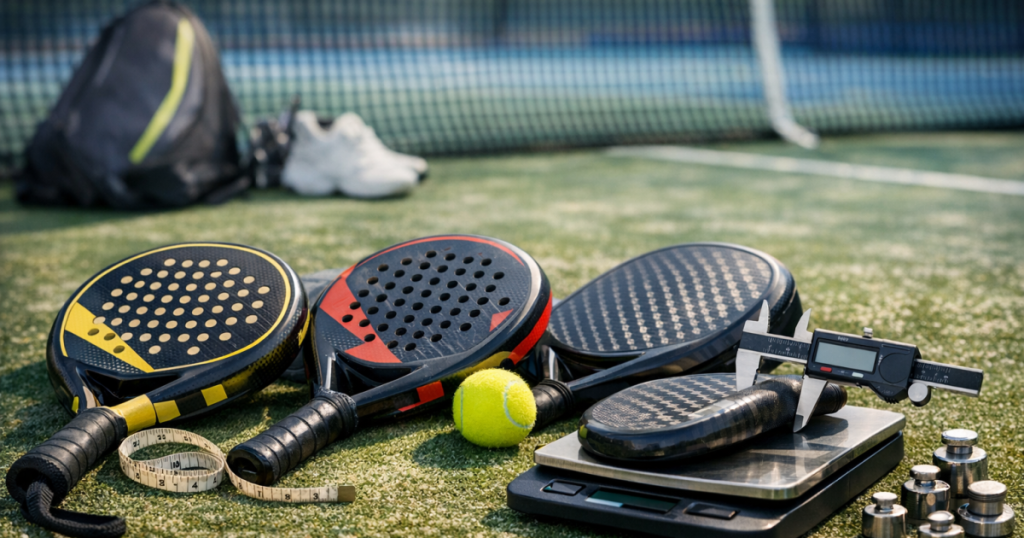
Racket weight is usually shown in grams. Many adult padel rackets are listed somewhere around 340 g to 375 g, although brands may quote a range rather than one exact number. The final feel can also change when you add an overgrip, protector strip or dampener.
A lighter racket can feel easier to move, especially at the net when you need quick reactions. It may also be kinder on the arm during longer sessions. The trade-off is that very light rackets can feel less stable when blocking faster shots or when you make contact away from the centre.
A heavier racket can feel steadier through the ball, but only if you can swing it comfortably. If the racket starts to feel slow late in a session, your timing drops, your volleys get rushed and your defensive shots become harder to control.
How to read weight as a beginner
- Under about 350 g: often feels easier to handle, but check whether it still feels stable enough on volleys and blocks.
- Around the mid-350s to mid-360s: a common comfort zone for many developing club players, depending on strength and swing style.
- Above about 370 g: can feel solid, but may be demanding for newer players, especially with a head-heavy balance.
Do not judge by the printed weight alone. Two rackets with the same listed weight can feel very different if one carries more mass towards the head.
Balance: why two rackets of the same weight feel different
Balance describes where the racket feels heaviest. This is usually discussed as low balance, medium balance or high balance. Some brands give a balance point measurement, but many simply describe the feel.
A low-balance racket carries more of its weight towards the handle. It normally feels easier to manoeuvre, which helps with reaction volleys, defensive digs and late adjustments. This is why many beginner-friendly rackets lean towards lower or neutral balance.
A high-balance racket carries more mass towards the head. It can help generate power if your technique is already consistent, but it can also make the racket feel slower and more tiring. For new players, the extra leverage is not always helpful because mistimed shots become more common.
Medium balance sits between the two. It can be a good stepping stone once you have reliable contact and want a bit more weight behind volleys and overheads without going straight to a demanding attacking frame.
Shape: round, teardrop and diamond
Shape is one of the easiest specs to understand because it often matches the racket’s playing character.
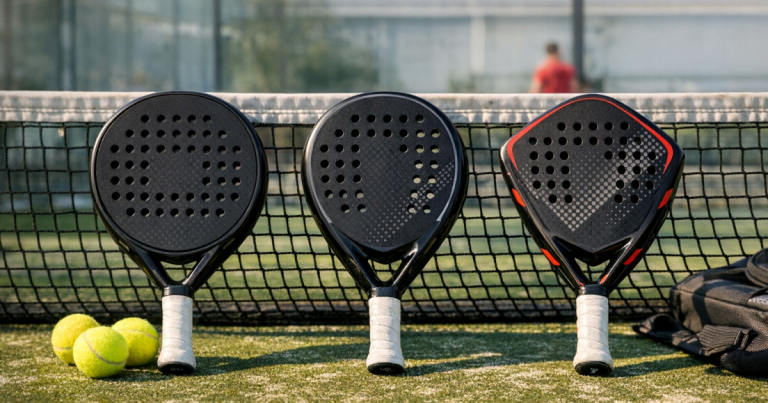
- Round rackets usually have a larger, more central sweet spot. They are commonly the most forgiving choice for beginners and defensive players.
- Teardrop rackets sit between control and power. They can suit improving players who want a little more attack without losing too much forgiveness.
- Diamond rackets tend to place the sweet spot higher and can feel more powerful but less forgiving. They are usually better for confident players with cleaner timing.
There are exceptions, because materials and balance also matter. Still, if you are choosing your first proper racket, shape is a useful shortcut. A round or forgiving teardrop design is usually easier to live with than a stiff, head-heavy diamond racket.
Sweet spot: the spec you may not see on the label
The sweet spot is the area of the face where contact feels cleanest and most controlled. Bigger sweet spots are helpful because beginners rarely hit the exact centre every time, especially when dealing with the back glass or awkward low balls.
Brands may describe a racket as forgiving, easy to use or control-focused, but they do not always give a neat measurement for sweet spot size. Shape, hole pattern, balance and face construction all play a part. If you want a deeper explanation, the guide to padel racket sweet spot size, shape and forgiveness explains how those details affect real rallies.
For beginner club play, forgiveness usually beats raw power. If a racket helps you keep one more ball in play, it is doing more for your development than a model that only feels impressive when you connect perfectly.
Thickness, length and face size
Most adult padel rackets are listed as 38 mm thick. That number matters because 38 mm is the standard maximum thickness used for padel rackets. It does not automatically tell you whether a racket is powerful or forgiving, but it confirms the racket is built to the normal adult format.
You may also see dimensions for length and width. Standard adult rackets are broadly similar in overall size because the sport has defined equipment limits. For most beginners, small differences in length or face outline are less important than weight, balance and shape.
Junior rackets and some lighter recreational models may differ more noticeably. If the racket is for an adult beginner, check that it is an adult padel racket rather than a junior or training model.
Core and surface: soft feel versus firm response
The core is the foam or rubber inside the racket. Product pages may use terms such as soft EVA, medium EVA, hard EVA or foam. Softer-feeling rackets can be more comfortable and can help slower swings get the ball moving. Firmer rackets can feel more direct and stable, but they may be less forgiving if your contact is inconsistent.
The surface, or face, is often described using materials such as fibreglass, carbon or mixed constructions. As a broad guide, fibreglass faces often feel softer and more accessible, while carbon constructions can feel firmer and more responsive. That is not a guarantee, because each brand builds rackets differently, but it is a useful starting point.
Some rackets also have a rough or textured face. Texture can influence grip on the ball, but beginners should not treat it as a magic spin feature. Technique, timing and shot choice matter far more.
Control and power ratings are not universal
Many racket pages show ratings such as control 9/10 or power 8/10. These can be useful within one brand’s range, but they are not standardised across the whole market. A control rating from one manufacturer is not directly comparable with a control rating from another.
Use those ratings as a quick hint, then look back at the physical details. A round, lower-balance racket with a forgiving face is more likely to behave like a control racket than a head-heavy diamond frame, whatever the marketing scale says.
It also helps to think about your actual misses. If you hit too many balls into the glass, into the side fence or long under pressure, a more powerful racket is unlikely to fix the problem. A more manageable racket may give you the time and confidence to improve the shot.
What to prioritise for your first regular club racket
If you are moving from hire rackets to your own setup, avoid chasing advanced specs too early. A sensible beginner profile would usually include a comfortable weight, low to medium balance, round or forgiving teardrop shape and a medium-soft feel.
That does not mean every new player needs the same racket. A strong player with tennis experience may adapt faster to a slightly firmer teardrop model. A player who values comfort, defence and consistency may prefer a softer round frame for much longer. The important point is to match the racket to your current game, not the game you hope to have in six months.
If you are unsure whether ownership makes sense yet, the guide to renting versus buying padel gear can help you decide whether to keep using club kit for a little longer.
Helpful questions
Is a heavier padel racket always more powerful?
No. Extra weight can add stability and momentum, but only if you can swing the racket well. For beginners, too much weight often reduces timing and control.
Is 38 mm thickness good for beginners?
Most adult rackets are 38 mm, so the number alone does not make a racket beginner-friendly. Look at weight, balance, shape and feel as well.
Should beginners avoid diamond-shaped rackets?
Most beginners are better served by round or forgiving teardrop rackets. Diamond shapes can work, but they usually demand cleaner timing and better control.
Do carbon rackets suit new players?
Some can, but many carbon-faced rackets feel firmer. A softer or mixed construction may be easier while you are still building consistency.
How much should I trust brand control and power scores?
Treat them as brand-specific hints, not universal measurements. Physical specs and on-court feel are more useful than a single rating number.
Key takeaways
The most useful racket numbers are the ones that affect your contact quality. Weight tells you how demanding the racket may feel. Balance tells you how quickly it moves. Shape gives you a clue about forgiveness. Thickness confirms the standard adult format, but it is rarely the deciding factor.
For most beginner and early club players, the best choice is not the most powerful-looking racket. It is the racket that helps you relax, react quickly, hit the sweet spot more often and keep the rally alive. Read the specs, but let comfort and control guide the decision.